Good Day Mockingbird

Issue № 11 The Thief

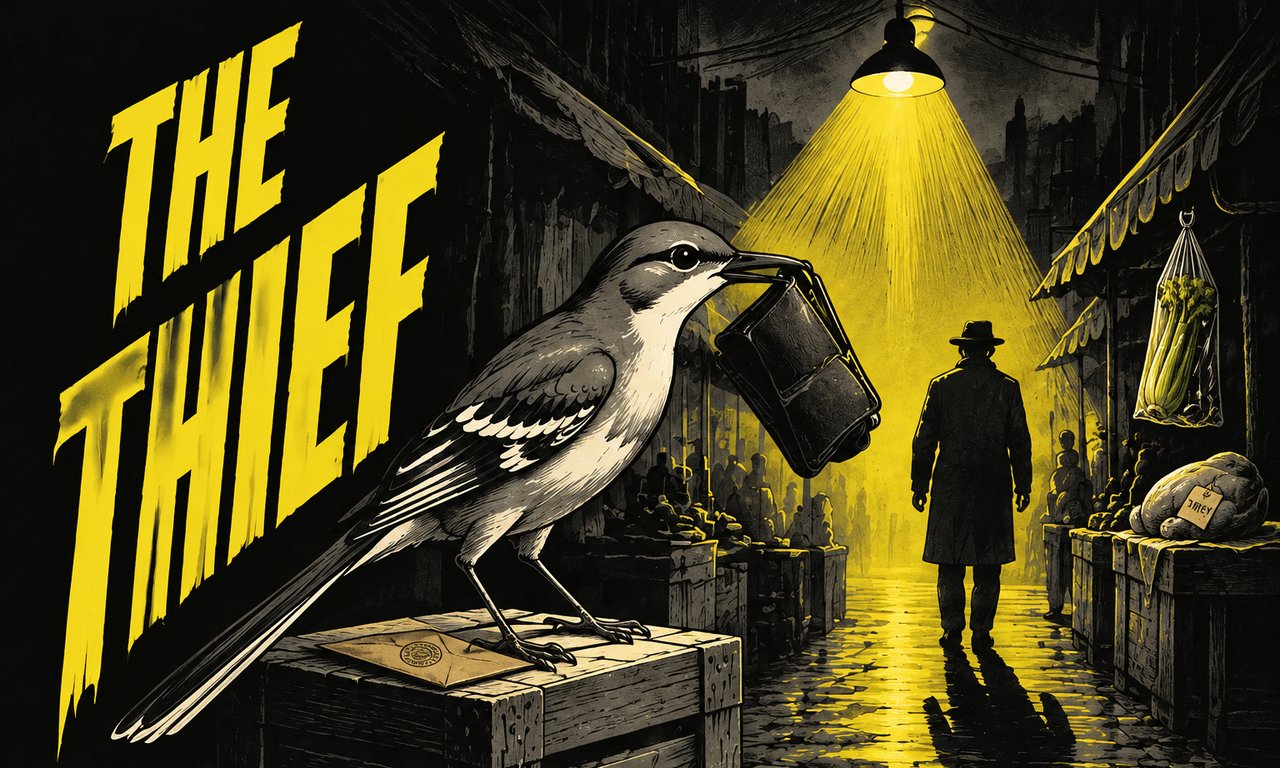
A 1940s film-noir movie poster in black, smoke grey and acid yellow, the words THE THIEF in tall slanted yellow lettering stacked down the left, a market alley at night under a single hanging lamp with a man in a long coat and hat walking away down the wet cobbles, and in the foreground a grey mockingbird standing on a wooden crate with a man's black wallet in its beak, a brown envelope on the crate beside it, a bag with a head of celery hanging from a stall hook at the right.

Three people who take, and the rules they take by. In Tokyo in the Olympic autumn of 1964, a man who used to log other people’s lost things for the railway walks the market under the Ueno tracks looking at the ground, hands in everything he finds, and keeps a notebook of the dates the law will make each thing his. In a city market under an iron roof, a till clerk who has done her shoebox finds that the beloved man upstairs has been stealing twelve minutes a day from everyone for thirty years, and opens a notebook of her own, ruled like a wage book, to take it back to the penny. And in Santiago, in the Vega Central on the Saturday before the Eighteenth, an old garlic seller who once worked the Metro in three countries watches a boy with a bag of celery lift his best customer’s pension, and has to decide which of el Flaco’s rules still holds.

From the Editor’s Desk

There is a saucer by the register at a certain kind of shop, and the sign on it says take a penny, leave a penny. Nobody wrote the rules for the saucer, and everybody knows them. You may take what you need to make the change come out. You may not take the saucer. You may not take a penny on your way in, before you’ve bought anything, and you may not take four. A nickel in the saucer is a gift; a dime is a mistake somebody will be too embarrassed to correct. The shop would never miss what the saucer holds in a year, and the shop would notice in a week if the saucer were gone, because the saucer is not there to hold pennies. It is there to say that this is a place where a small amount of taking is allowed, so long as you take it in front of everyone, from the dish, by the rule.

Continue reading →

In this issue

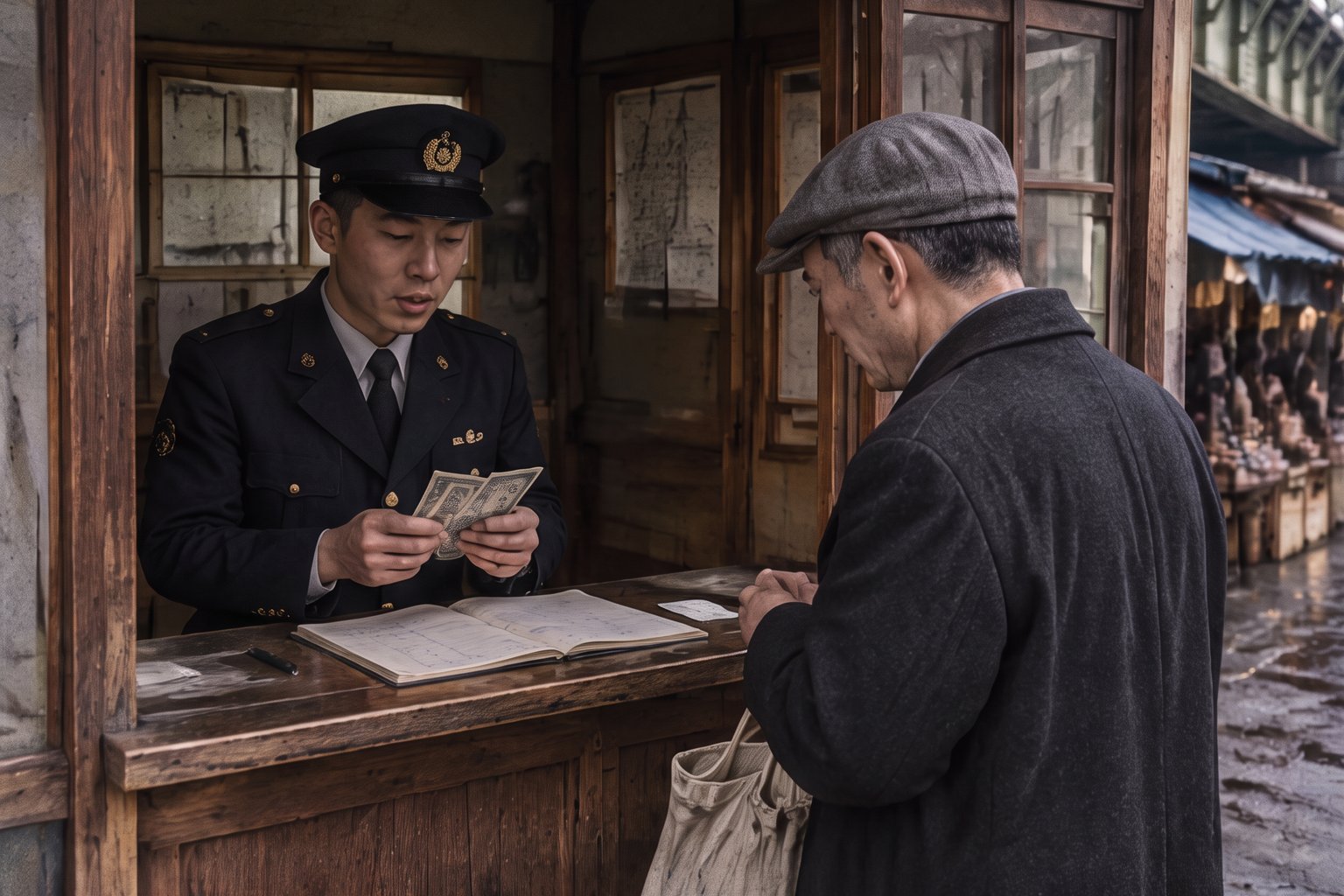
A muted 1960s color photograph through the open window of a small wooden police box at the mouth of a Tokyo market: a young police officer in a dark uniform and peaked cap counts banknotes held in both hands over an open ledger on the counter, while an older man in a grey cloth cap and dark overcoat, seen from behind with a cloth bag in his hand, watches the count; market stalls and a wet street beyond.
I

Six Months

Tokyo, the market under the Ueno tracks, the Monday after the Games opened. Ōhashi logged other people’s lost things for the railway for sixteen years, and now he walks the market looking at the ground. What he finds he hands in at the police box, every time, because the law gives an unclaimed thing to its finder six months after the notice goes up, and a tenth of its worth if the owner comes. Under the squid stall’s crates there is a bank envelope, thick, with no name on it. He writes two dates in his notebook. Then, three days before the second one, a woman in a dark coat comes to the window with a paper from the police station. A thief by every rule but the one the law wrote.

Read the story → 8 min
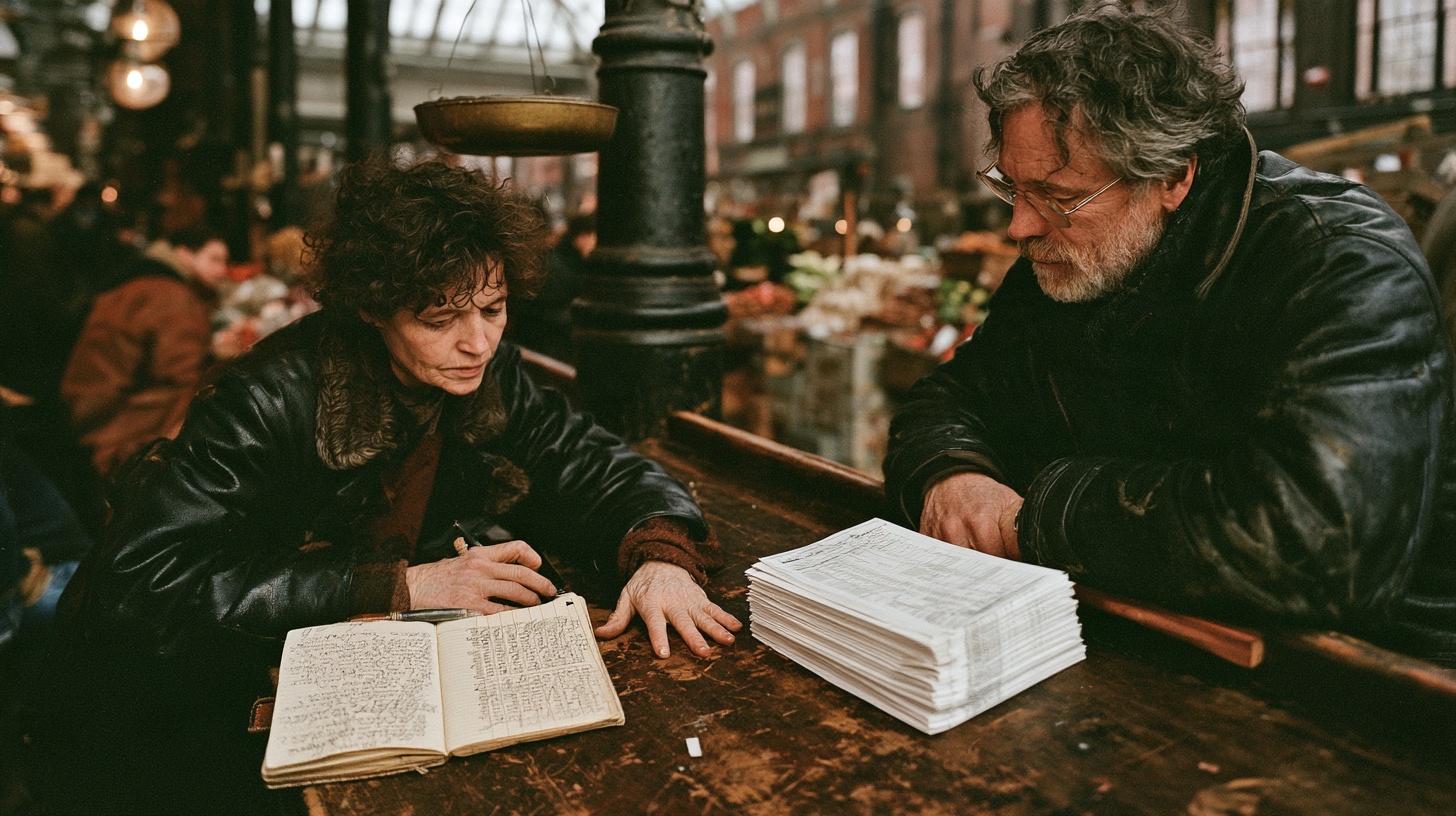
A color photograph in a covered market with an iron roof and brick walls, a hanging brass scale behind, at a long dark wooden table, a woman in a black leather coat with curly dark hair bent over an open handwritten notebook with a pen, her other hand flat on the table, and across from her a grey-haired bearded man in glasses and a black jacket leaning on a thick stack of printed ledger sheets, both looking down at the books.
II

Even

Everyone at the City Market loves Gene Prewitt, who gives every employee a turkey with their name on the tag in his own hand. Tess Looby has run his tills for eight years, and when a sixteen-year-old runner asks her why his first stub is two hours short, she goes home and does her shoebox: the clock that rounds like a man owed money, the pay that runs bell to bell, the shortage deductions. Two thousand nine hundred dollars. She takes the number to nobody. She opens a notebook instead, ruled like a wage book, and starts counting down.

Read the story → 9 min

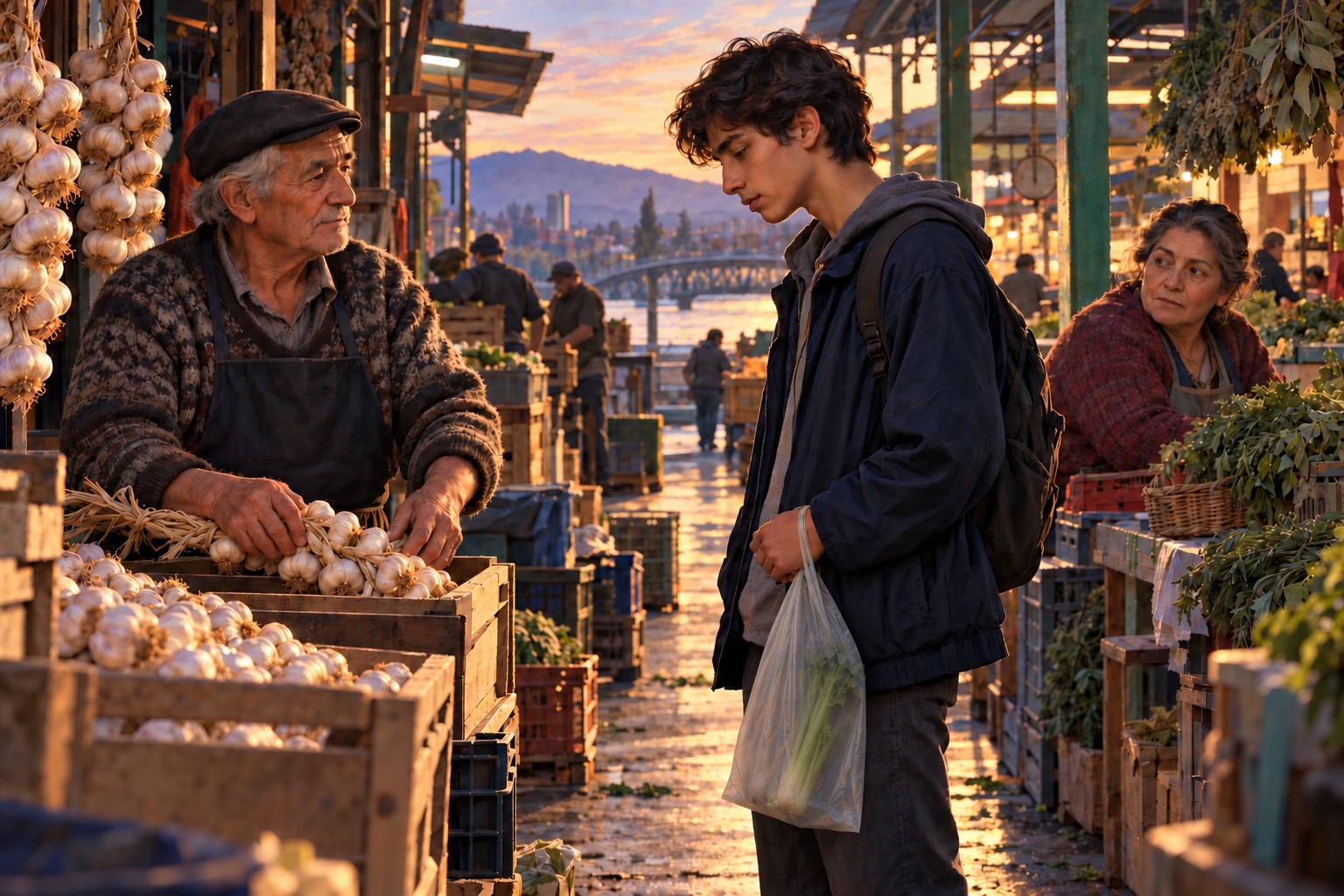
A photographic market scene at golden hour under an open shed, an old man in a flat cap and patterned sweater and apron behind crates of garlic with braids hanging above him, looking across at a young man in a navy jacket with a backpack who stands in the aisle looking down at the garlic, a plastic bag with a single head of celery in his hand, a woman with grey hair among herbs at the right, and a river and an arched bridge in the haze behind.
III

Casera

Santiago, La Vega Central, the Saturday before the Eighteenth. Lucho has sold garlic from the same puesto for twenty years, and before that, for longer than that, he took wallets out of pockets in Madrid and Paris and Rome, by three rules a man called el Flaco taught him at fourteen in this market. You don’t run. You don’t hurt anybody. And you don’t work the Vega’s own. Señora Inés has bought her ají from him every Saturday for fifteen years, with her hand on the pocket where the purse is, and this morning the purse has her pension and the aguinaldo in it. A boy with a bag of celery has seen the hand too.

Read the story → 9 min