Issue № 11 · Story III
Casera
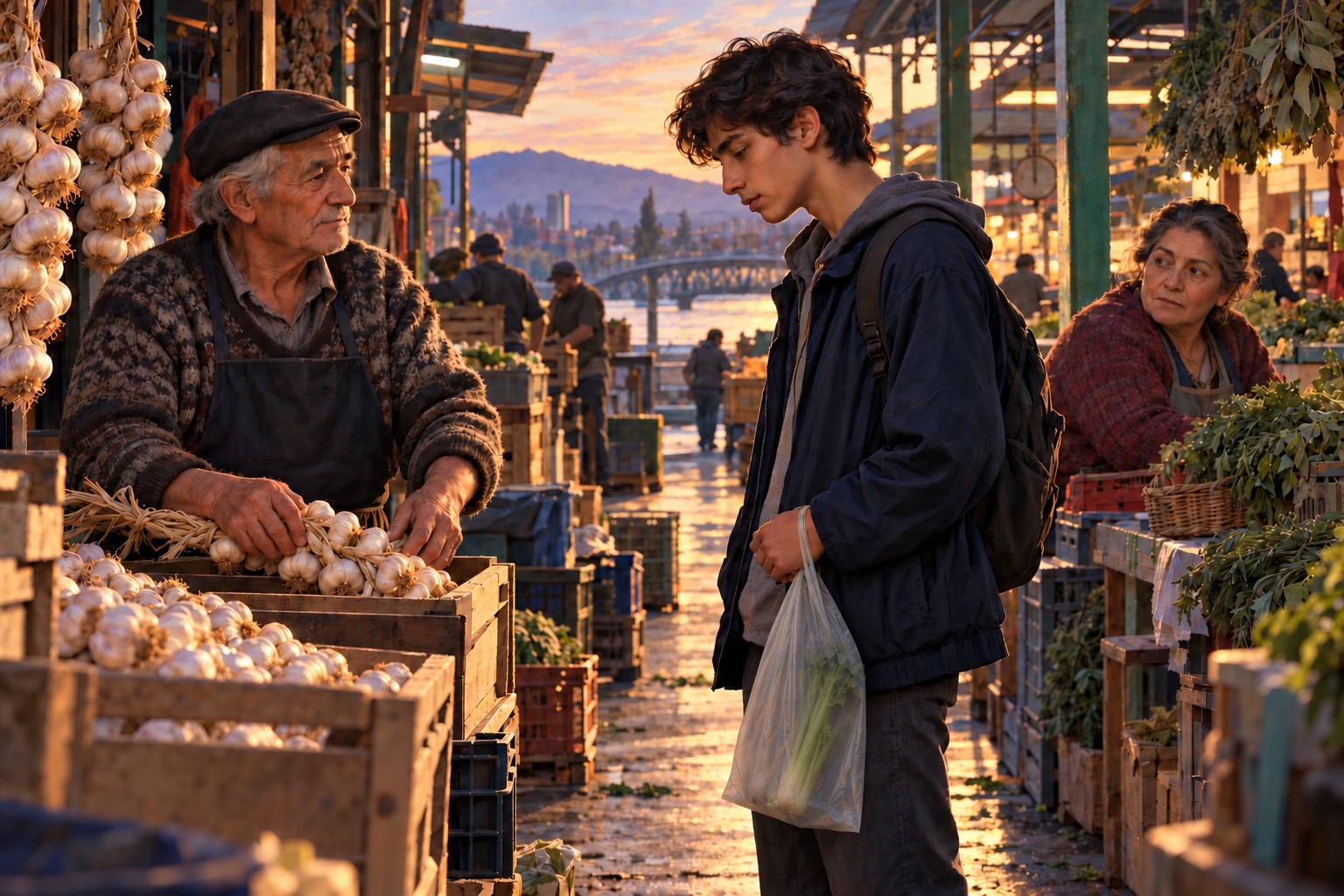
Santiago, La Vega Central, the Saturday before the Eighteenth. Lucho has sold garlic from the same puesto for twenty years, and before that, for longer than that, he took wallets out of pockets in Madrid and Paris and Rome, by three rules a man called el Flaco taught him at fourteen in this market. You don’t run. You don’t hurt anybody. And you don’t work the Vega’s own. Señora Inés has bought her ají from him every Saturday for fifteen years, with her hand on the pocket where the purse is, and this morning the purse has her pension and the aguinaldo in it. A boy with a bag of celery has seen the hand too.
Santiago, La Vega Central, the Saturday before the Eighteenth.
The Vega opened before light on the Saturday before the Eighteenth of September, and by seven the aisles were full of people who had come early to beat the crowd and were the crowd.
Lucho had his garlic up by six. The braids hung from the bar over the puesto, white and purple, and under them the loose heads in crates, the dried cacho de cabra in a heap like red claws, and the green ají in a tub with a wet cloth over it. Somebody had strung flags the length of the shed during the week. The porters came through with their carts loaded to the height of a man, shouting for room, and the room was made every time at the last moment by people who had not looked round.
He was sixty-eight. He had sold garlic for twenty years, and before that, for longer than that, he had taken wallets out of other people’s pockets in Madrid and Paris and Rome.
He had learned it here, at fourteen, from a man everyone called el Flaco, who sold nothing and was in the Vega every day. El Flaco taught him three things before he let him touch anything. You don’t run. You don’t hurt anybody. And you don’t work the Vega’s own. Not the vendors, not the porters, not the caseras, the regulars who bought from the same puesto every week and called the man behind it casero. A market was a house, and you did not steal in the house you ate in. You worked the people who came to look at the market.
In 1979 Lucho flew to Madrid with two others on tickets bought by a man he never met. He worked the Metro, and the Rastro on Sundays, and later the Paris Métro and the 64 bus in Rome, from Termini to the Vatican. In those years a wallet could hold a month’s wages. By the early two-thousands it held cards that were no use to him, and photographs of other people’s children. He came home with his ficha clean, not one arrest at home, and not much else, and his cousin sold him the puesto.
Marta had the herbs next to him. Cilantro, parsley, mint, bunches of oregano tied with blue string. Her husband had drunk with el Flaco in the old days. Marta had never said a word to Lucho about that, or about anything else it meant, in twenty years.
Señora Inés came at half past eight, as she did every Saturday, pulling her shopping cart behind her on its two small wheels.
She was older than him and walked as if the aisle had been put there to slow her down. She bought a braid of garlic most months and a quarter of dried ají every week, and she paid from a coin purse with a brass clasp that she kept in the right-hand pocket of her cardigan. Every so often, walking, she put her hand flat on the pocket to feel it there.
He had watched her do it for fifteen years. Every lanza in the world knew what that hand meant. It told anyone who was looking exactly where to go. He had thought, most Saturdays, of telling her to stop. He had never done it, because he could not tell her without telling her how he knew.
“Casero,” she said. “A braid. The good one.”
He took down the good one. She opened the purse to pay, and it was fat. The notes were folded twice and pressed in tight under the clasp.
“They paid Thursday,” she said. “The pension, and the aguinaldo on top, twenty-five thousand extra. The government thinks I’m going to spend it on chicha.” She took out a note and closed the clasp. “I’m buying tomatoes.”
“For the Eighteenth.”
“For my son. He comes Friday from Rancagua. He’ll eat what I put in front of him and tell me the tomatoes in Rancagua are better.” She put the purse back in the cardigan pocket and put her hand on it. “Ají too. A quarter.”
He weighed the ají and gave her the change and she went on down the aisle toward the tomatoes, the cart rattling behind her, her hand going to her pocket once and then again.
He had seen the boy at twenty to eight.
Nineteen, maybe twenty. Clean white shoes, a navy jacket too heavy for the morning, and a plastic bag with one head of celery in it, held by the handles. He walked against the crowd and stopped at no stall long enough to be asked what he wanted. He was not looking at the vegetables. He was looking at hands, and at what bags were carried on which side, and at who had a phone in a back pocket.
Lucho had watched him the way one tradesman watches another, without meaning to. The celery was right. A man with a bag of shopping is a man shopping. The boy’s walk was right too, slow and a little bored. Somebody had taught him. Lucho had decided it was none of his business. The tourists came down to the fruit end later in the morning to photograph the cherimoyas, and they were fair game by any rule Lucho had ever kept.
Now the boy came back up the aisle, and turned, and fell in behind Señora Inés.
Lucho put down the scoop.
Ahead of them a porter’s cart had come off a side aisle, stacked with sacks of potatoes, and the porter was calling for room, and the crowd folded into itself around him. Señora Inés stopped. The boy stopped behind her. He lifted the bag with the celery in it in his left hand, high, to keep it out of the crush. Everybody near him would have looked at that bag. Lucho looked at the right.
It was very good. It was over before the porter had finished shouting. The right hand went in at the cardigan and came out and went into the right pocket of the jacket, and the boy said “Permiso, permiso” with the rest of the crowd and let the press carry him on past her. Señora Inés said “Ay, perdón” to the porter, who had not touched her, and went on.
The cart moved. The aisle opened.
Lucho thought about it once, which was all the time there was.
He could shout. The porters settled things in the Vega. There were men walking around Santiago who had been settled by them and walked differently afterward. The boy was young and had good hands, and in a minute he would not have them.
He could say nothing. Señora Inés would go to pay for her tomatoes and put her hand in the pocket and find nothing there. Her September was in that purse.
“Watch the stall,” he said.
Marta looked at him, and then at the aisle, and said nothing at all. She moved her stool a foot toward his garlic.
The boy did not hurry. He went down to the end of the shed where it opened onto Antonia López de Bello, and stopped at the cart where a woman fried sopaipillas in a drum of oil, and bought one, and stood eating it out of a square of paper with the celery bag hanging from his wrist.
El Flaco used to say that the minute after a lift was the only minute a lanza could be robbed. He thinks it’s over, el Flaco said. He’s already spending it.
Lucho bought a sopaipilla. He stood at the boy’s right side. When the woman put the bowl of pebre on the board he reached across him with his right hand for the spoon, and said “Perdón, joven,” and his shoulder touched the boy’s shoulder, and his left went into the jacket’s right-hand pocket and out again. The purse was in his own trouser pocket before the boy had finished saying de nada.
His hands had done it. He had not been sure they would.
He left the sopaipilla on the board and walked back up the aisle.
She was at the tomato stall, choosing. Don Ramón was holding the bag open for her, and she was turning each tomato before she put it in. Both her hands were in the tomatoes. She had not touched the pocket since the cart.
Putting back was harder, and in all his years Lucho had never had to find out how much. A pocket being emptied didn’t notice, el Flaco said. A pocket being filled felt the weight arrive.
A porter was coming down behind him with an empty cart, fast, and shouting. Lucho let the cart push him. He went into the crowd at her back with everyone else, and said “Permiso,” and his hand went to the cardigan pocket and held its mouth with two fingers and let the purse down into it, slowly, the last inch slowest, and came away.
Señora Inés put a tomato in the bag.
“Two kilos,” she said to Don Ramón, and put her hand on her pocket, felt the purse, and went on choosing.
Marta was serving a woman with a list. When the woman had gone she said, “Did you get what you went for?”
“A sopaipilla.”
She looked at his hands. “You haven’t got it.”
“I ate it.”
She went back to her parsley.
The day came in on top of them after that. By ten the aisles were so full that the porters stopped shouting and simply waited. People bought for the Eighteenth as though there would not be another. Ten kilos of onions, sacks of potatoes, whole crates of tomatoes carried out between two men. Lucho sold braids of garlic to women who were cooking for twenty and loose heads to men who had been sent with a list. He sold out of the green ají by noon. A gringo couple photographed his braids and bought one. When they asked what it was for, he told them it kept away the devil. He told all of them that.
In the slow hour after lunch he found that he was going over it again.
Not Señora Inés, and not the boy. The sopaipilla cart. The bowl of pebre, the spoon, the shoulder, the weight of the purse coming out of the jacket into his palm. He went over it as he used to go over the good days in Rome, on the bus back to the room, step by step. He was most of the way through it for the third time before he noticed what he was doing.
An hour before the Vega closed, the boy came up the aisle.
He still had the celery. He stopped at the front of the puesto and stood there with the bag swinging from his wrist and looked at the garlic. He did not look at Lucho’s face. He looked at his hands taking the braids down from the bar one at a time and laying them in a crate.
“That señora was your casera,” the boy said.
“Here they’re all somebody’s casera.”
The boy thought about that. He had a long face, and he was younger close up than he had been in the aisle.
Marta had stopped tying oregano.
“How much?” the boy said, and touched a head of garlic in the crate.
“Three for a thousand.”
The boy took his hand away. He did not buy anything. He stood a moment longer, and then he went back down the aisle toward the river and the bridge, slowly, the bag at his side, and the crowd closed behind him.
Lucho took down the last braid. He laid it in the crate with the others. His hands were steady.
♥ 2026 Paul Titangos · CC BY 4.0 · a story from Good Day Mockingbird № 11