Issue № 7 · Story III
True Color
Summer 1987. Rita Silveira has sold color prints of the sunset through the rock’s arch for eight summers. Then the bronze on the railing tells the tourists the arch fell in 1906, and her true photograph starts looking like a lie. So she learns what a true photograph is worth when it’s twice as old.
The plaque went up last October, and by the second Saturday of the summer Rita Silveira has been called a liar four times.
She keeps count on the back of a receipt book. It isn’t a big thing. The boardwalk is a year old. The city built it over the old cannery yard with a seawall, a railing, a saltwater taffy shop, Rose Bettencourt’s chowder stand at the west end with a ship’s bell over the door, and three coin-op binoculars aimed at the sea lions on Penny Rock. They cost a quarter for ninety seconds. The city gave the vendors’ carts a painted strip of planking along the railing, and Rita’s is the fourth pitch down from the chowder stand, where the smell of fried clams reaches but doesn’t settle. She has sold photographs on this shore since 1971, from a card table on the old cannery slab before there was any boardwalk, and she knows what sells.
The Eye sells.
It is the best picture she ever took. She took it June 21, 1979, from the bench above the spring, with a Pentax on a tripod and her third roll of the evening. The sun is going down through the arch at the western end of the rock, dead center, a red coin in a black ring, with the whole face of the rock gone copper and the sea lions on the Ledge black against the water. She prints it herself, Cibachrome, eight by ten, in a cream mat. It has paid her gas and her rent and her son’s tuition for eight years. People buy it for their mothers.
Then in January of 1983 the storms came, one after another, the worst anybody had seen, and on the fourth night Rita didn’t sleep. At first light she drove down to the bench in her robe and saw the rock with two horns and a gap between them, like a tooth that had been pulled. The roof of the Eye was in the Channel, and white water was going through where the sky had been. She stood there in her robe until a patrolman asked her if she was all right. She said she was, and went home and printed forty of the Eye, because she knew what had just happened to its price.
She sold those forty by August, and forty more the next year. It became the picture of a thing that wasn’t there any more, which is a better picture to sell than a thing that is.
There’s a third picture, and it doesn’t sell at all.
On June 21, 1983, the first midsummer after the fall, she went back to the bench with the same Pentax and the same tripod and waited for the sun. It went down through the Gap. That’s what the rock does now. The Gap is wider than the Eye ever was, and ragged, and the sun doesn’t sit in it the way it sat in the ring. It slides down the inside of one horn and drops into the water a little off center, like a coin that missed the slot. The sea lions are on the Ledge. The light is the same copper. It is, she thinks, technically the better photograph.
She printed twenty. She keeps them in a box under the cart, and she has sold four in four summers, all to people who live here. The tourists pick it up, look at the rock behind her, look back at the print, and put it down, because they can see that for free. Nobody has ever once asked her if it’s real.
The plaque is cast bronze, bolted to the railing twelve feet from her cart. It has raised letters, and at the top there’s a little relief of the rock, still showing the Eye, because the city had the pattern drawn up years ago and nobody paid to change it. Somebody keeps the top line polished; Rita has never caught who. It says:
PENNY ROCK · NAMED “LA PEÑA DE LOS LOBOS” BY SPANISH EXPLORERS FOR THE SEA LIONS WHICH HAVE MADE IT THEIR HOME SINCE TIME IMMEMORIAL. ITS FAMOUS NATURAL ARCH, “THE EYE,” COLLAPSED IN THE GREAT EARTHQUAKE OF 1906. THE WHITE MARK ON THE POINT WAS PAINTED BY THE PENNY COVE PACKING COMPANY TO GUIDE ITS SARDINE FLEET HOME. · PLEASE DO NOT DISTURB THE MARINE MAMMALS · CITY OF MONTEREY 1986
The tourists read the plaque. Then they come to her cart and look at the Eye in color.
“That’s not real,” says a man in a Giants cap. “Honey, look, it says right here, 1906.”
“I took it in 1979.”
“They didn’t have color film in 1906.”
“No,” says Rita. “They didn’t.”
“So it’s a painting.”
“It’s a photograph. I took it.”
He looks at her as if she has tried to sell him the Golden Gate. Then he goes to the binoculars and puts in a quarter.
By the Fourth of July she has sold six of the Eye in color, against thirty-one the summer before. The receipt book says so.
She takes the receipt book down to the chowder stand after the lunch rush and lays it open on Rose’s counter. Rose reads it, wiping her hands, and doesn’t say she’s sorry, which Rita appreciates.
“It’s the bronze,” Rose says. “People believe bronze.”
“You were on the seawall in ’83. You saw it.”
“Half the town saw it.” Rose tips her head up the boardwalk toward the plaque. “I went to the city the day they unveiled it. Recasting is four thousand dollars and a new fiscal year. They sent a laminated correction in April. It lasted eleven days in the salt.”
“So what do you do?”
“I tell them.” Rose ladles a bread bowl for a woman in a visor without looking at the ladle. “The long version, over chowder. They stand still for it, mostly. Come down here and tell them yours, Rita. You’ve got the picture. Nobody’s got a better witness than a picture.”
“I sell pictures,” Rita says. “I don’t sell stories.”
“Everybody on this boardwalk sells stories,” says Rose. “Some of us just give them away with the soup.”
Rita takes her receipt book back up the boardwalk. She doesn’t tell anybody the long version. She stands at her cart through the whole afternoon with the color Eye on the left where it’s always been, and every time somebody reads the bronze and walks straight past it, she feels it the way you feel a step that isn’t there.
The next morning she brings the Herald.
She has kept it in a drawer since the day after the fall: the front page of the Monterey Peninsula Herald, a photograph across four columns of the rock with its two new horns and the surf going through, under a headline in type an inch high. She tapes it to the front of the cart, under the color Eye, with clear tape at all four corners. It is the most honest thing she has ever put on the cart. It is proof.
Nobody reads it. Eyes go to the headline and slide off, the way they slide off a menu in a language they don’t read. The Giants caps and the visors look at the clipping, and then at the bronze, and the bronze wins, because the bronze is bolted to the railing and the clipping is taped to a cart.
By the end of July the sun has done to the newsprint what the sun does. The page has gone the color of weak tea, and the photograph has faded to a gray ghost of a rock. A man in a windbreaker taps it with one finger and says, “Is that from the earthquake?”
Rita looks at it for a long time after he’s gone.
The next Saturday a woman from Visalia with two daughters stands at the cart holding the color Eye, and says, not unkindly, “It’s a shame it isn’t the real one. If it was really from before the earthquake, I’d buy it. That’d be something. That’d be a hundred years old.”
Rita watches her walk off to the taffy shop.
That night she goes into the darkroom she built in the garage in 1968, pulls the 1979 negative, and for a while she doesn’t do anything with it. She holds it up to the safelight. There’s the ring and the coin, backwards and black. She thinks about Rose ladling the long version into bread bowls for free, and about the clipping on the cart, gone the color of tea in four weeks. A true print is a thing that tells you when. That’s all it’s for. It says: I was there, and it was like this, then.
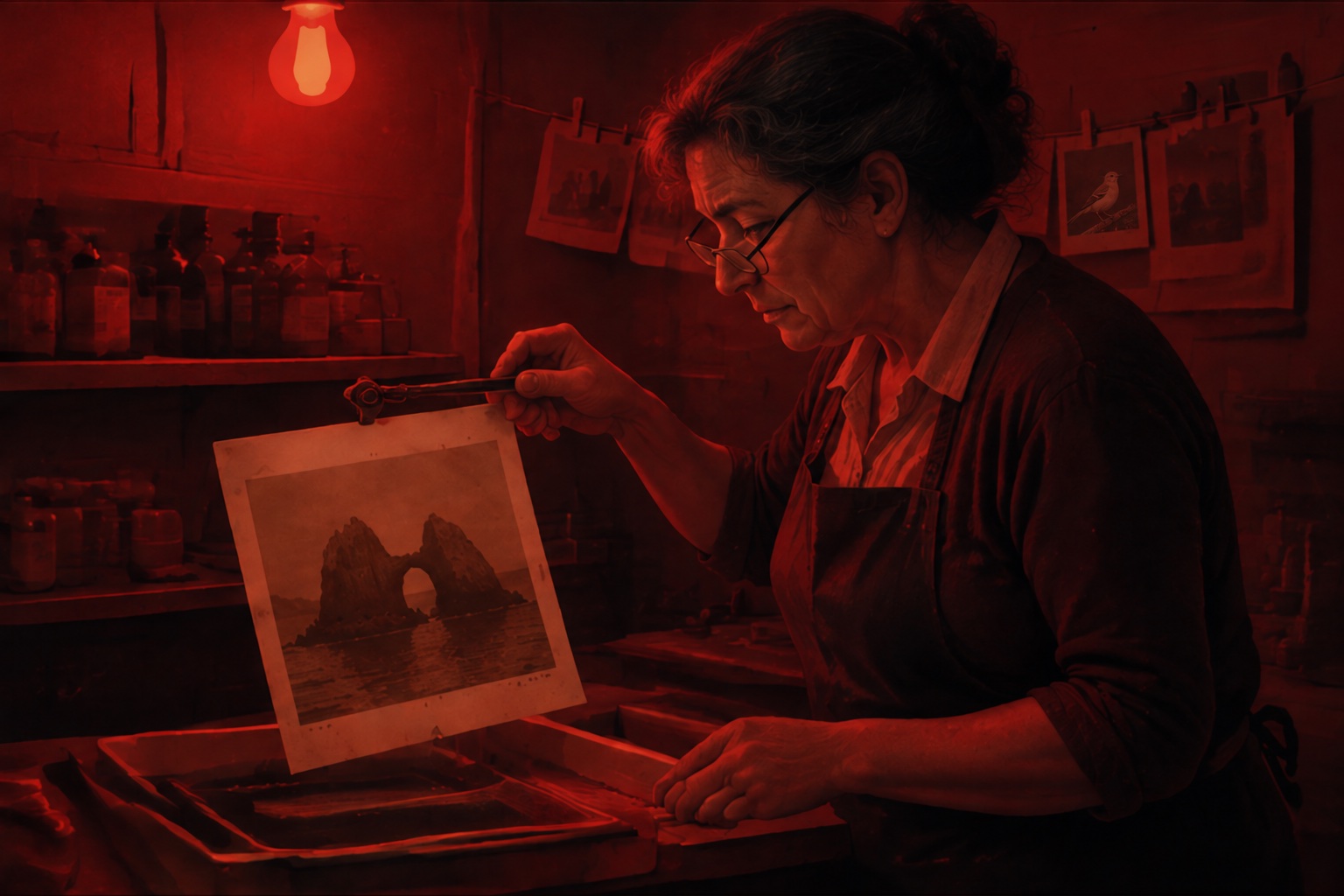
Then she prints it in black and white on the old fiber-based paper she’s kept in the cold drawer for years, the stock that goes a little yellow at the edges. She prints it soft. She burns the sky down until the sun is only a pale disk in a dark arch. Then she tones it in sepia, one print and then another, until it’s the brown of a photograph in a drawer at a dead aunt’s house. She dries it, flattens it, and trims the border with the deckle-edge cutter she bought for wedding work and never used. In the morning light it looks like 1900. It looks like a thing that was there once, and gone, and remembered by somebody.
She mats it in gray.
She sells four the first Saturday, at forty dollars each. The woman from Visalia would have bought two.
By Labor Day she has sold sixty-three. A man from a gallery in Carmel who deals in early California views comes by on a weekday and asks, carefully, whether she has any more of the “old Penny Rock pictures,” and whether they’re family material. She says they are. He buys ten at thirty dollars apiece, to sell at ninety, and says he knows people who collect. Rose watches the whole thing from her counter with her arms folded.
“Look at you,” she says, when the man has gone. “Believing in bronze.”
“Shut up, Rose.”
“I’m not saying anything. I’m admiring.”
She doesn’t stop selling the color one. She keeps it on the cart, on the left, where it’s always been. Some people still buy it. They’re mostly locals, and people who were here in ’83, and people whose mothers stood on the bench one June. A little boy asks her which one is real, the brown one or the colored one, and she says they’re both real photographs, which is true. His father buys the brown one.
Nobody asks about the box under the cart. Rose bought one of the Gap in June and hung it by the bell, and when tourists ask her which rock is the real one, she points out the door.
On the first of September she letters new price cards in her good hand with a fine black pen and tapes them to the cart. The first one goes under the color print, on the left:
THE EYE, PENNY ROCK. SUNSET, JUNE 21, 1979. $8.
The second one goes under the sepia:
PENNY ROCK WITH THE EYE. ANTIQUE VIEW, BEFORE 1906. $40.
♥ 2026 Pete Kaminski · CC BY 4.0 · a story from Good Day Mockingbird № 7