Issue № 4 · Story I
The Dog at Anjos
Four flights down at eight, four flights up when up becomes the cheaper option. A retired bookkeeper, a free bench at the left end of the Anjos platform, a kiosk she prices and declines once a day, and a dog that gets off at her stop, which is not the same as getting off for her.
Four flights down at eight, four flights up when up becomes the cheaper option, and nothing in between that costs money. That is the shape of the morning. Graça set it nine years ago, the winter the left knee delivered its terms, and the terms were one descent and one ascent per day, and she accepted them as she accepted every hard number in forty-one years of keeping other people’s books, without argument, because arguing with a number is a thing done by people who have never worked with numbers.
The walk to the station is six hundred meters, downhill, and the knee permits it. The senior pass was forty euros in January, eleven cents a day, a number small enough to round to zero, which she has, which makes it zero, which settles it. She taps through the gate at eight-twelve, the same beep every morning, and takes the station stairs down to the platform.
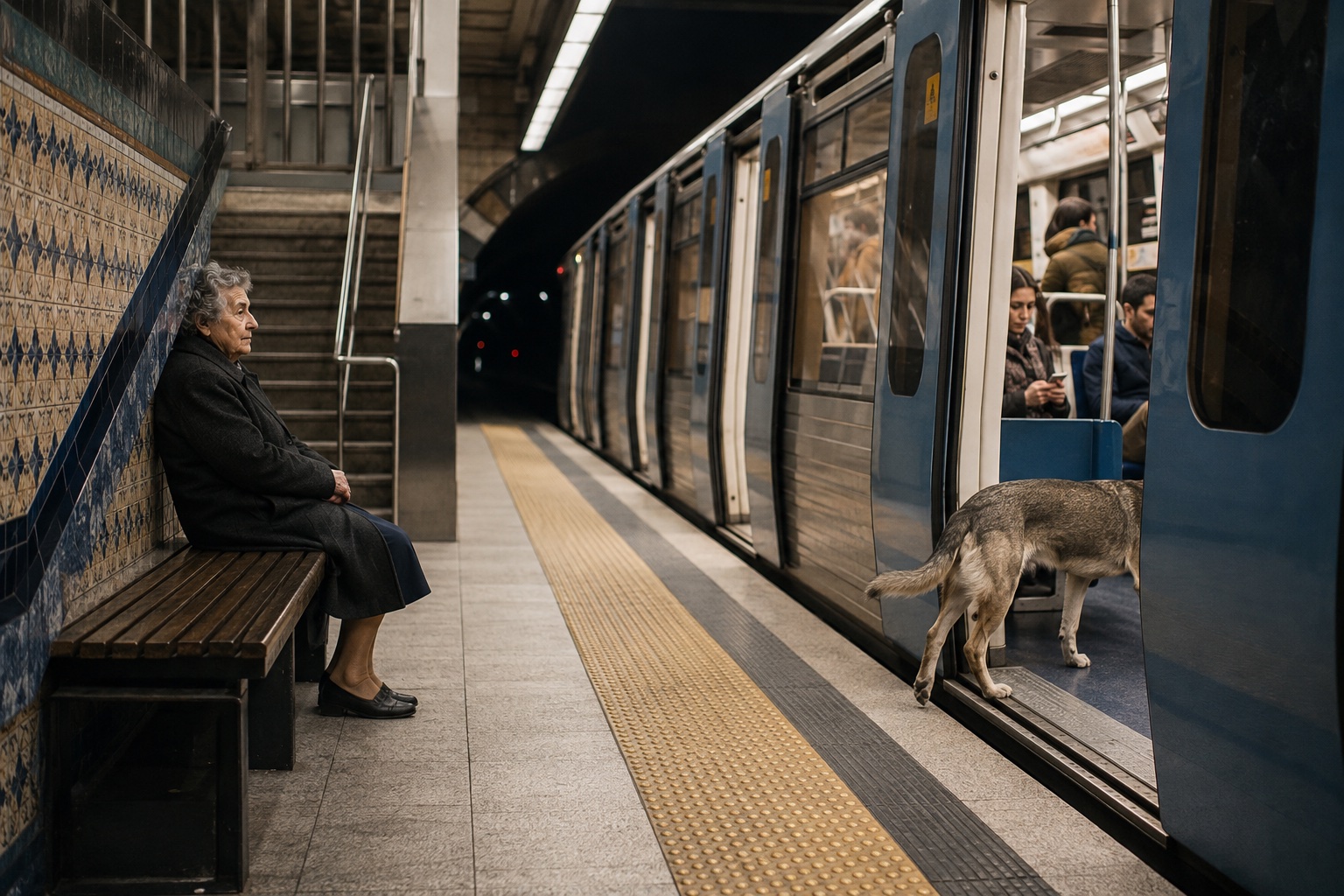
The bench at Anjos is the solution to the hours between. Platform level, left end, up against the tile where the stairwell wall breaks the draft. She chose it nine years ago for the wall, and only later noticed the second advantage: from the left end you can see both edges of the platform without turning your head, both tracks equally, which she had no use for at the time and files now as she files any accidental confirmation that a good decision compounds. She is there by eight-fourteen. She leaves when the cold and the knee and the clock agree that the apartment has become the lesser expense. Ten most days, ten-thirty in January, never eleven, because by eleven the platform belongs to the tourists and the strollers and the people who ride the metro as they do everything, without once asking what it costs.
She knows what it costs. She knows the café upstairs charges one euro eighty for a coffee. Three and a half loaves at the discount bakery on Rua da Palma, or the hourly interest on money she does not have. She knows the woman who takes the window table every morning with a laptop the size of a tea tray does not finish the coffee. The woman is paying one euro eighty to rent a chair. Six hundred and fifty-seven euros a year — Graça has run it more than once, the way you press a bruise — and six hundred and fifty-seven euros is four months of electricity, or a winter of gas, or seven months of the telephone her niece calls on every Sunday for between four and seven minutes, depending on whether the children are in the room. The calls are sufficient. The niece is handled. Sunday has a line in the budget and the line is small and it balances.
The bench costs nothing, and nothing is the correct price for sitting. This is not an opinion but the kind of fact the world has stopped teaching.
There is a kiosk at the head of the platform — coffee, pastries, cigarettes, the lottery — and she has priced it once a day for nine years and declined it once a day for nine years. The man who runs it stopped offering sometime in the first winter, which she has counted in his favor ever since. A bica there is ninety cents. Half the café upstairs, and ninety cents more than the bench.
The dog rides down from the Martim Moniz direction to Anjos and back the same way. She has never seen it board, and she has never seen it exit anywhere but here. The dog’s arrival is a flat diagonal trot through the closing doors — no scramble, no drama, the entrance of something that has done its sums. Three minutes with her, and then it is gone. Medium-sized. Short coat the color of a building nobody has painted in decades, a grey-tan she could not name and would not try to. No collar. Not thin. It eats. Not fat. It works for what it eats. An animal that has solved its own situation without filing an application with anybody, and Graça extends it the respect she extends a clean set of books: silence.
Not her discovery. The eight-o’clock regulars step around it with the unremarking care you give a fixture. The kiosk man throws it the heel of a pastry some mornings and it takes the heel as a toll, without gratitude, which she approves of. Gratitude is a payment, and the dog does not overpay. It belongs to the line like the cracked third tile, known, unclaimed, answerable to no one.
It gets off at Anjos. Not for her. It got off at Anjos before she chose the bench and it will get off at Anjos after her knee retires her from the stairs entirely. Its route runs through Anjos and so does she. That is all it is. It crosses to the bench. It sits at the left end. She occupies the left end. The dog leans, the small sideways settling of a dog against the nearest vertical thing, her calf. The pressure is perhaps five kilos of a thirty-kilo animal. It looks at the tunnel mouth, she looks at the platform, and neither looks at the other. After three minutes it stands, crosses the platform, and boards the first train back the way it came. Where it exits she has never confirmed, and Martim Moniz is her best guess only.
The busker by the far pillar sets out his guitar case and seeds it — she has watched him do it — with four fifty-cent pieces from his own pocket, and the fraud is not the seeding, everyone seeds, the fraud is the denomination: he is instructing the public in what a song is worth, at a rate he invented. She has never given him anything. She never will. She would sooner tip the tile.
Some mornings a man stands at the yellow line with his bag between his feet and his body over the edge and the arriving train moves his hair, and Graça watches him and thinks what she always thinks about people who stand at the edge of platforms, which is that the distance between the yellow line and the drop is the same distance as the margin in a ledger between the number and the binding, and if you write in the margin the page is ruined, and if you don’t need to be told this you are an adult and if you do there is no telling you.
The fare notice goes up on the pillar in the metro’s clean blue type: an increase, effective the first of the month. She reads it once and has the annual figure before she has finished disliking the font. Eleven euros, six loaves and a tin of sardines, transferred from her table to the Metropolitano, which in nine years has not fixed the third tile or found the source of the draft the stairwell wall only half defeats.
Another morning a woman exits the eight-twenty with a suitcase built for a different century of travel, broadside in the doors, conducting a war against the carriage, the gap, and the platform in turn. Graça convicts her from the bench before the doors have closed: the suitcase has wheels, the station has a ramp, the woman has chosen struggle over geometry, and people who choose struggle over geometry are the same people who pay one euro eighty to rent a chair. There is no shortage of them. There is no curing them. The metro exists to carry them past her at speed.
Some mornings it carries them in numbers. A walking tour comes down the stairs at five past nine, twenty-two of them behind a woman with a closed umbrella held up like a standard, lanyards, a small speaker on her hip that gives her voice to the whole platform whether the platform wants it or not, and for the length of one train they own the place. They fill the rest of the bench, and the near ones sit closer than the fare entitles them to. They stand three deep at the kiosk, and the kiosk man sells more in four minutes than in the hour before it, bicas and water and the pastries he keeps under glass for exactly this, and Graça does his arithmetic for him from the left end and arrives at a figure that would cover her electricity for a month. They photograph the tiles. They photograph the cracked third tile. They put fifty-cent pieces in the busker’s case, fifty cents each, because the case has told them what a song costs and they have no way of knowing it was lying. Thirty-five euro a head for three hours of being walked to things; she has heard the guide say it. Seven hundred and seventy euro, minus the guide, minus the company, minus the umbrella. The train comes. They board it all at once, in the order the umbrella decides, and the doors close, and the platform is hers again, and the tile is a tile.
And through the mornings, the dog. Down the line and back, the trot, the left end, the lean. Five kilos. Three minutes. She has never touched it. She has never fed it, because feeding it would put it on the books, and the books are closed to it; the one recurring item in her morning that carries no cost, requires no maintenance, asks for no line. It arrives on its own schedule and leaves on its own schedule, and a schedule that does not depend on her is the only kind she has ever fully trusted, because she is seventy-four and she maintains the stairs and the budget and the Sunday telephone, and the maintenance is the whole of her estate, and it is enough. It has been enough for a long time.
A morning. She has not numbered them. Numbering them would be an entry, and there is no ledger open for this. Simply a morning, then. Eight-fourteen, left end, draft blocked, the platform in its usual light.
The train from the Martim Moniz direction arrives. The doors open. Commuters, a delivery man with boxes, a girl reading as she walks.
No dog.
She notes it the way she noted, for forty-one years, a column that failed to agree — not with alarm; with attention. An expected figure has not appeared. The doors close. The train draws out.
The next train is three minutes. She remains seated. This requires no justification: the street is cold, the bench is free, the knee prefers stillness. The train comes, opens, empties, fills, closes, goes.
No dog.
One more. Three more minutes. She does not turn her head toward the tunnel and she does not scan the platform, because looking is a declaration and she is declaring nothing. She is a woman sitting on a free bench in the warm. It is what she is every morning. It is all she is doing. The third train arrives and departs, and the six minutes are complete, and six minutes is what she cannot stop herself from pricing even now, a loaf of bread’s worth of time, spent on the bench past her usual hour, entered against no account she is prepared to name. She stands, and her knee states its position, and she crosses to the station stairs.
Up to the concourse, through the gate (the beep) and out onto the street, and the six hundred meters back uphill, which the knee tolerates on its usual terms, by taking longer than it used to.
Four flights. She takes the rail.
She is on the second flight when the arithmetic finishes without her permission, as it always finishes, as it finished with the café woman and the busker and the eleven euros. The six minutes were not nothing. Nothing is the correct price for sitting, and she did not sit for nothing; she sat for something, twice over, three minutes a time, and a thing paid for twice is not an accident, it is an entry — the first entry, and forty-one years of books have taught her exactly what a first entry is. It is the one that opens the account. It is the one that makes the second entry possible.
She climbs. The stairs are the same stairs. Tomorrow is eight-fourteen, the left end, the tile, the draft; and whether the account stays open is not a thing she decides on a staircase, and she is still climbing, hand on the rail, two flights below the door.
♥ 2026 Paul Titangos · CC BY 4.0 · a story from Good Day Mockingbird № 4