Issue № 4 · Story II
The Fire at Qasr Saffron
A sandstorm buries the west road and a caravan pulls in at a desert inn, where the courtyard becomes a market for one night and the keeper makes the strangers tell stories. Every tale is somebody’s own. Dawn shows whose.
By sunset the west road was gone. Not closed; roads in that country became other things: floodbeds, rumors, graves. This one had become sand. A storm had crossed the flats an hour before dusk and buried the markers to their tops, and the caravan master, after swearing at the sky, the camels, the surveyors, and three dead kings, admitted that they would spend the night at Castle Saffron, which Assad called Qasr az-Za’farān and nobody else did.
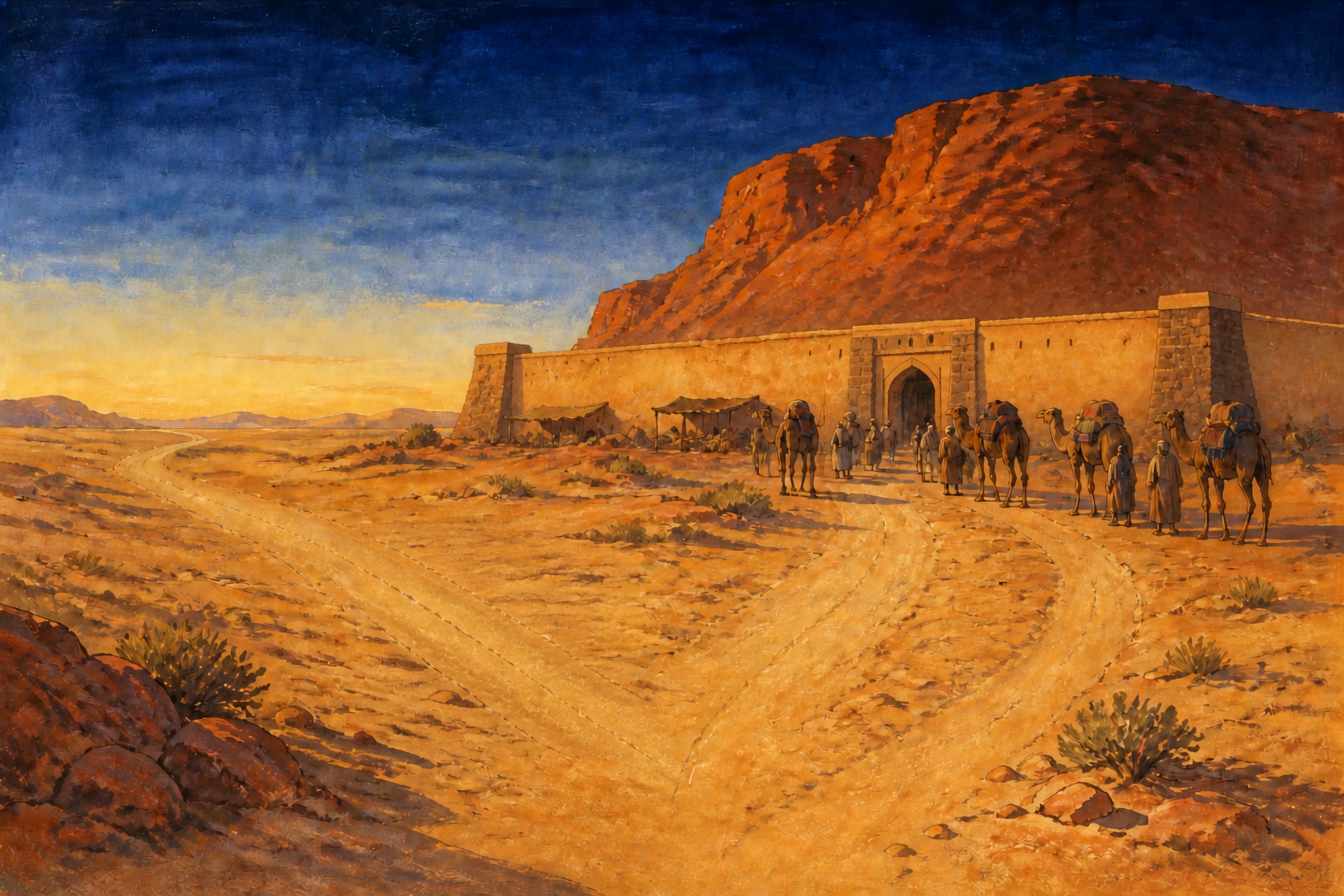
It stood by itself under a red cliff: a square wall around a courtyard, stables below and sleeping galleries above, the plaster gone at the corners down to fire-blackened stone. Travelers came in off four roads before the gate shut. The last of them came in alone. A carpenter, judging by the bag on his shoulder, through the tail of the storm with a cloth over his mouth. By then, the courtyard had become a market.
The bales that had been going somewhere came off the camels and were opened where they lay, because a bale that is not moving might as well be selling. The cook set up under the gallery stair and sold lentils by the bowl and flatbread by the round and a stew he called mutton, at a price that went up while the carpenter watched. A tinker put out a scale and bought iron by weight: buckles, a cracked pot, a knife with no handle. A man whose camel had gone lame in the storm was trading it and a purse to another man for a sound one, at a rate so bad that both kept saying it aloud, and shook on it anyway, because dawn would not wait for a better one. At the end of the row a thin sunburned young man had opened a leather case of twelve stoppered bottles on a blanket and hung a card of prices on the lid. Morning fog. Two hours of rain. Cool shade. Wind. The wind was the dear one.
Assad took his cut of all of it. He was the keeper, a narrow old man born in this courtyard, who had never, he said, been farther away than the well. His tariff was so much per beast, so much a bale, a bedroll in the gallery for the price of a bowl, and for a room, a door that shut, a price he named after looking at your boots. The carpenter had good boots. He paid what Assad said, and took the last room. He stood in the doorway of it with his bag of tools and knew that he had not needed it. He went back down to the fire.
By full dark there were twenty of them. The wind worried the shutters. From the stable, at intervals, a camel made a noise like a chair being dragged across a stone floor, and its owner, an old merchant with forty years of the route in his face, apologized for it each time as though it were a child.
“Tell stories,” said Assad.
When nobody moved, he added, “Travelers have stories.” The spice seller said that travelers had lies. Assad replied that the good ones were both. Then he pointed at the woman nearest the fire, a clerk going south with ink on her fingers, and said, “You first,” and she did as she was told.
Hers was about a stall that sold names, secondhand, in little boxes, for the price of a breakfast. A woman bought one for a joke, and by midnight strangers were remembering her under it: a merchant who had done business with her, a soldier who apologized for a siege. At dawn, when the caravan master called her real name, she looked down the road toward the village of the woman she had bought and did not answer. The clerk stopped there and looked at the ink on her fingers as if it were somebody else’s.
“I know something about not going on,” said the old merchant, and told them, in a few sentences, about a camel that would not stand up, and stopped before the end. The chair-noise came from the stable on cue, and people laughed. The old merchant did not.
“Nobody here finishes anything,” said a man in a blue sash, to the fire.
There were two couriers at the fire and everybody had noticed them. The one who had spoken wore the blue sash of the northern chancery and the other the red of the southern. They had spent dinner not looking at each other, which was more conspicuous than staring. The carpenter had seen them earlier at the weather seller’s blanket, one after the other, asking after the same bottle: the northern one wanted a wind out of the south at his back tomorrow, the southern one the opposite, and there was one bottle of wind, and neither had bought it.
Assad pointed at him. “Since you object,” he said, “you tell the next one.”
The northern courier looked across at the southern one, and then he spoke, the way a man does who has decided to say a thing carefully so that he can deny having said it.
“Two messengers met at an inn during a war,” he started. One rode north and one rode south, each carrying a sealed proposal of peace from one side to the other, which neither was permitted to read, though each had been told what it contained. You do not carry the words, you carry the seal, and you have been told a version for the road.
The messengers sat at one fire because there was only one fire. Over wine, the northbound messenger said that his king had offered to withdraw from the river.
“There is no wine here,” said the southern courier. “Assad doesn’t sell it.”
He had not spoken all evening. The northern courier looked at him, and at the fire, and at him again.
“Tea, then,” he said. “Over tea.”
“And the southbound messenger said that was strange,” the southern courier said, “because his queen had been told the king was demanding the river.” He was looking at nobody. “That is what he had been told to say on the road.”
So they compared, the northern courier went on, more slowly now, everything each had been told, the southern courier supplying his half, and none of it matched: the king offering what the queen had been told he demanded, the queen conceding what the king had been told she refused.
The messengers argued about which court was lying, said the northern courier, and the southern courier said no, they did not argue, they arrived together at the thing that was worse: that perhaps neither court was lying, and someone between them, some hand the seals had passed through, wanted the war to go on. They sat up until dawn, the northern courier said, with the two packets on the ground between them.
“And?” said the spice seller.
“That is the story.”
“That is not an ending.”
“It is the only honest one. They had three choices. Deliver the messages as they were. Exchange them, so that each court received the version the other had been told. Or put both in the fire and ride home and say the road took them.” He turned a twig in his fingers. “I never heard what they chose.”
“Then perhaps,” said Assad, “someone else here knows.”
The southern courier said nothing. He had his hand flat on the satchel at his hip, the way a man keeps a hand on a thing he has decided not to think about.
The woman beside him had said nothing, all night. She had arrived alone and wore no ornament but an iron ring at her belt, the kind a housekeeper carries her keys on, with one key on it. Everyone had noticed that; one key on a ring is a stranger thing than twenty.
“Mine is about a key,” she said, before Assad could point, and told it.
There was a woman, she said, who locked a door with someone on the other side of it. She locked it from the outside and took the key, so that nobody could open it who was not her. Because she did not trust herself, she walked far enough away that she could not open it either. The key hung on a ring and the ring hung on her belt, and every inn she stopped at, she meant to leave it on the counter in the morning, and every morning she counted her things and it was still among them. She had tried to sell it once, to a locksmith, who said it was a good key and asked what it opened, and she took it back.
“What was behind the door?” asked the clerk.
“Someone.”
“Alive?”
“When I locked it,” the woman said, and her hand went to the key at her belt, and she heard herself, and did not correct it. Nobody asked her anything else.
The clerk put a piece of wood on the fire, slowly, as though the fire needed it.
The mapmaker, who had been mending a chart all evening by the cook’s lamp, said they were all too fond of unfinished stories and started one about a market where everything sold after midnight was unfinished, a song without its last note, a map with one road left off, the road he meant to take in the morning, until the spice seller cut him short. Assad let him.
Then Assad turned to the far side of the fire, where the carpenter sat with the keeper’s own three-legged stool across his knees, working the loose leg back into its socket with the heel of his hand. Assad pointed.
“I don’t have one,” the carpenter said.
“Everyone has one.”
“Then it’s about an inn,” he said. “A man comes in late, the last through the gate, and pays for the last room. An hour later a second man comes in, older, with the same face, and the same scar,” and he held up his right hand, palm out to the fire, and there was the white line across it where a chisel had gone through when he was seventeen, “and asks the keeper for the room. The keeper says the room is taken, and anyway the house doesn’t take the dead.
“The old man says he isn’t dead. He says he’s early. He wants the younger man out on the road tonight, in the dark, so that he will miss whatever’s waiting at the fork tomorrow. The younger one asks what. The old man won’t say. If I tell you, he says, you’ll only find another way to make the same mistake.”
“So what does he do?” asked the clerk.
“He asks the old man what happens tomorrow. And the old man says, you choose.”
“That’s all?”
“That’s always all.”
Assad stood up. “Bedrolls,” he said. Nobody moved, and then somewhere beyond the wall a rooster, badly informed, announced the day.
The market that had made itself in the courtyard unmade itself in half the time. The bales were roped shut, the cook’s pot was scraped, the lame camel stood at the gate under a new owner and the sound one under a worse one.
The caravan master walked the line calling the roll, and when he called the clerk’s name she was not in the line; she was standing with the two drovers who were going east, and did not answer, and he called it again, and a moment later she answered to something else, and he wrote it down without looking up.
The two couriers sat on an upturned barrel by the trough with the two packets laid side by side between them, seals up, not talking. The old merchant was in the stable unloading his camel, all of it, stacking the bales against the wall as though they were going to stay. The weather seller stood with the one bottle of wind held up against the paling sky, turning it, as if to see which way the thing inside it leaned.
At the tinker’s scale the woman with the iron ring put her key on the pan, and the tinker looked at it and at her and said, “By weight? A bowl,” and she said, “A bowl, then,” and the ring went back on her belt empty. She was eating when the carpenter passed her. She looked up, and nodded, and went on eating.
He went to the gate with his bag. He had not been up to the room. Assad was there, lifting the bar from the gate, the night’s tally on a string of knots at his wrist.
“Which story was true?” the carpenter asked.
Assad considered it. “Wrong question.”
“What’s the right one, then?”
The keeper pulled the gate wide. The light came in across the courtyard and reached the fire, which folded softly in on itself and became ash. Outside, the four roads went off into the morning, the west one still under its sand.
“Which one changed you?”
He did not wait for an answer; he had the tinker’s cut to collect, and the cook’s, and went to collect them.
The carpenter looked at the west road, which was where the work was, and always would be. Then he looked at the others. The mapmaker went past him with his chart open, and knelt in the sand at the fork, and began drawing in a road. The carpenter shouldered his bag and went out, and did not turn west.
♥ 2026 Pete Kaminski · CC BY 4.0 · a story from Good Day Mockingbird № 4