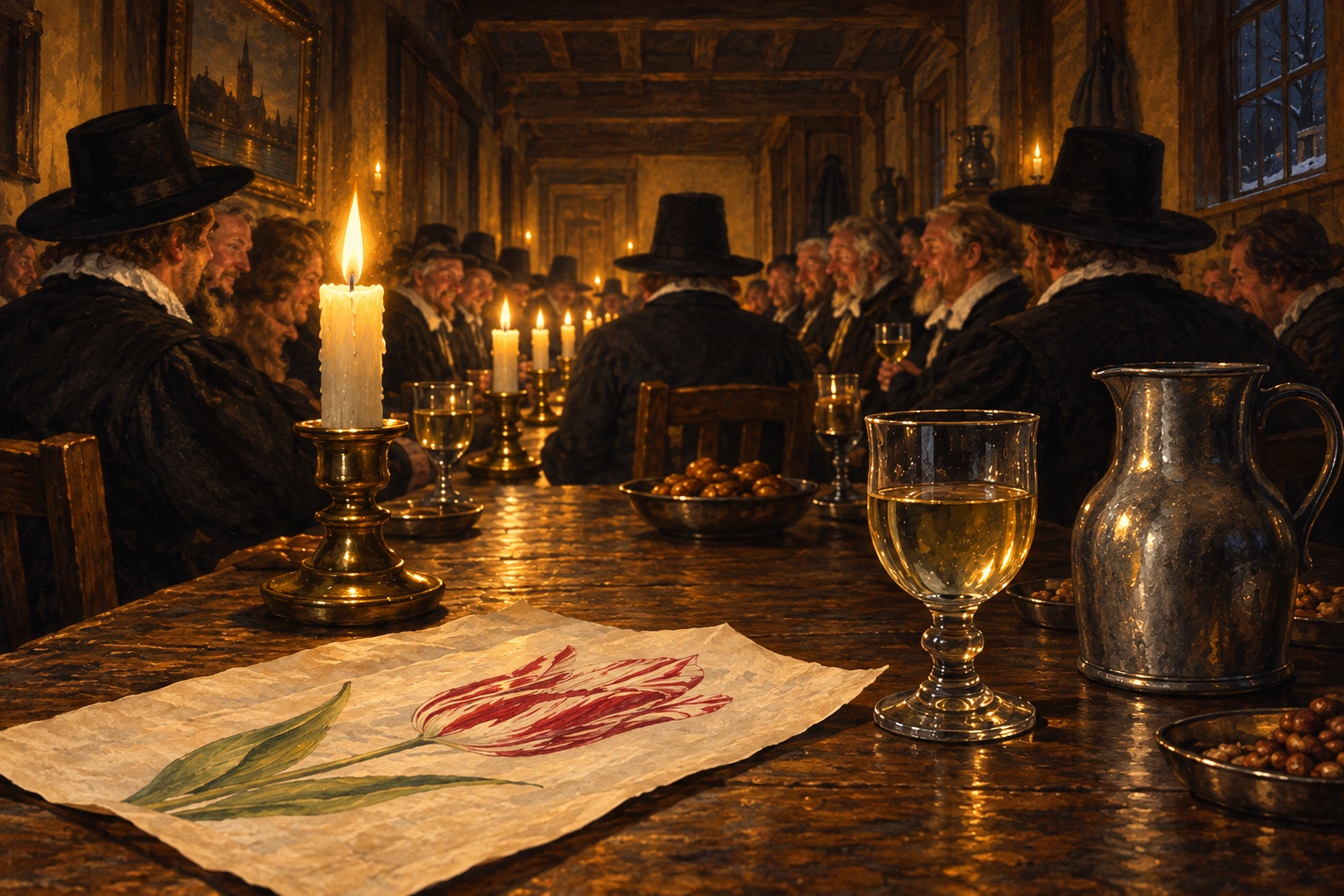
Issue № 5 · Story III
The Wine Money
A tavern in Haarlem, a winter evening in 1636, and a grain man from Hamburg who has been coming eleven weeks and wants to be one of the men who is told things first. A watercolour of a flower nobody can see, twelve hundred grains’ weight of something still in the ground, and the round that seals it.
The room at the Gulden Vlies was cold until five in the afternoon, and I was in it from four, which is how I came to know what a collegie looks like before it is one.
It looks like a room. A long table with the benches still up on it, a fire that has not caught, a girl carrying peat in her apron and not looking at me, and the slate on its nail by the door with nothing written on it. There were three of us there that early. The other two were the kind of men who are early everywhere. They had the sense to sit by the fire that was not lit and say nothing. I had walked twice around the Grote Markt in the dark to keep from arriving first, and had arrived first anyway.
I had been coming eleven weeks by then. I want that understood at the start. I was not a Holsteiner who wandered in off the ice.
In Hamburg I dealt in rye and in barley and I was good at it, and I will say what that means because nobody ever asks. It means you can put your hand in a sack to the wrist and know what has been done to it. Grain that has been wet and dried tells you in the smell before the hand gets there, a sweetness at the back of it, like a barn in August. Men will tell you that is a good sign. It is not. It means you know that a last out of Danzig in a wet year is a different animal from a last out of Danzig in a dry one, though the word is the same and the price is quoted the same, and the whole art is in the difference between the word and the thing. I could stand on the Kehrwieder at six in the morning and tell you what a cargo was worth before it was off the hoy. I was right. Being right about it made me a rich man in a decade when the Empire was on fire.
I did not suffer. Hamburg did not burn. We sold to whoever was outside the walls that season and we sold to the other one the season after, and I stood on the Kehrwieder and watched the people come up from Mecklenburg with what they could carry, and I did the arithmetic on the barley they would need and I did it accurately. I was twenty-nine that year. I have never once been able to say that story so that it sounds like anything but what it is.
So when I say I came to Haarlem for the flowers, understand that I came with money that was not clean and an idea that I had earned it, and that I wanted something out of a room that money does not buy, which is to be one of the men who is told things first.
Claes Bogaert brought me in. He is a linen man with a garden behind his house on the Kleine Houtweg and eleven beds in it, and he had been at the Gulden Vlies since before there was anything to be at it for. When he put his hand on my shoulder in front of the secretary in October the whole matter took about four seconds. Nobody asked me anything.
By half past four they were coming in in twos. By five the fire had taken and the benches were down and the room was full, and there was a great deal of noise in it, and it was all Dutch. My Dutch is a grain man’s Dutch. I can buy, I can complain, I can count to any number you like. I cannot follow six men at once when three of them are laughing.
Claes had the book out on the end of the table under the lamp.
I had seen tulip books before. A painter keeps a stock of them, sheets done from the flower itself in the season, and he has hundreds, and you sit with him and you choose. Everyone knows this. Nobody in that room believed a painting was a bulb.
“Mooi, hè,” Claes said, turning them over one sheet at a time and not stopping at any of them. “Die van Coorn heeft er negen.”
I did not know whether he meant nine sheets or nine beds or nine bulbs, and I did not ask, because by then I had learned that asking cost me more than not knowing. I said, in Dutch, that it was very fine.
“Ja,” he said, and turned another one.
But the sheet under his hand when he said it was an Admirael, with the flame going up out of the white in a way the ones before it did not do, and he did not say one word about it, and he left it lying there, and I looked at it for a while.
What was being sold that night was a weight. That is how it is done in the winter. The bulbs are in the ground where nobody can reach them and will not come out till the summer, so you buy so many azen of what will be lifted, and an aas is nothing. It is a grain of nothing. You would not see it on your palm. I knew all this. I could have explained it to you. There is a difference between knowing how a thing is counted and knowing what you are holding.
Then the boards came round, and that part I liked. They are little wooden slates, the size of a hand, and they are passed down the table in the order the secretary has written the names, and mine came to me with somebody’s chalk still on the edge of it where a thumb had been. The thousands and the hundreds and the tens and the ones go down the face one under the other. There is a moment when every man in the room has a board in his hand and nobody is saying anything. I have never seen a market do a thing so quietly.
You write what you are asking on your board. The man who has that sort to sell takes a board too. Then each of you names a man to stand for you, and the two who have been named put their heads together and set the price, high side and low side, somewhere between, and make a stroke on both boards beside the figures. After that there is no arguing with it. It is the most orderly thing I have ever stood in the middle of, and I have stood in the middle of the grain exchange at Hamburg on a Tuesday.
“Wie neem je?” the secretary said to me.
I looked at Claes, which is its own answer, and I gave it in front of everyone.
“Neem Willem,” Claes said. “Willem is eerlijk.”
So I named Willem Coorn.
Willem was fair. I have gone around it a great many times since and it always comes back to the same place. Willem Coorn was a fair man and he did a fair thing, and he had sat at that table with Claes Bogaert two evenings a week for nine years, and both of those facts were in the room, and only one of them was in the room for me.
The strokes went on the boards.
“Twaalfhonderd,” Willem said. “Eenkleuren. Twaalfhonderd azen.”
“Eenkleuren,” the secretary said, writing it.
Twelve hundred. I had the figure before he finished saying it. I have always been quick with a figure.
Then there is a moment, and this is the part nobody told me, where either of you may wipe your stroke out. If you both wipe, there is no sale. If you both leave it, it is done. If one wipes and the other does not, the man who did not wipe is fined by the secretary. I did not know that either. I did not know any of it. I only knew that Claes’s hand was flat on the table and not moving, and so mine did not move, and the strokes stayed.
“Nou,” a man across from me said. “Die slaapt vannacht.”
The table laughed.
I have thought about that laugh for a long time and I am fairly sure it was not at me.
What I bought was twelve hundred azen of eenkleuren. Plain ones. Whole colours. There is nothing wrong with them and there is nothing hidden about them. The word was said out loud twice, and I heard it both times, and eight years ago that is what you would have thrown on the muck heap behind the garden. Nobody said Admirael to me. Nobody said the flower on the sheet was the flower in the ground. The sheet was on the table under the lamp and I was the one who kept looking at it.
I did the sum once, walking back along the Spaarne that night, the way I would do it on a hoy before the hatches are off, and I had the figure before I reached the bridge. I did not care for it. I have not done it since.
The wijnkoop is a half stuiver in the guilder and it stops at three guilders, and everybody calls the three guilders drietjens. The buyer pays it. The seller spends it. What he spends it on is the room.
So the drink came. It came about a quarter past six and it went the length of the table and there was a good deal of noise about it, and Claes stood up with his hand on the back of my chair.
“Op onze Duitser,” he said. “Die beter telt dan wij allemaal.”
There was a knocking on the wood. I stood up too, because a man does, and the sentence I had ready came out sideways.
“Ik betaal het bier,” I said, “maar ik tel het niet.”
It was not the sentence I had. It was close enough to a joke that it went, and it went well, and that was the best four seconds I had in that town.
For about an hour after that I was in it. Men I had nodded at for eleven weeks put their hands on my arm to get past me instead of going round. Somebody argued with me about the war, in Dutch, slowly, on purpose, and I understood most of it and said something back that was not stupid. At the end of it he put his cup down.
“Jullie hebben geluk gehad,” he said. “In Hamburg.”
“Ja,” I said. “Wij hebben geluk gehad.”
That is all I said, and it was true, and he let it alone. We were in the ootje by then, all of us. It is their word for a small ring of people who are warm together. I had heard it said across the table about me more than once that winter, and I took it kindly.
They come in past seven, the ones who are only coming for the evening. The son of somebody, two weavers, a man who brings his boy. The benches fill up all the way to the wall. The candles get lit along the middle of the table because you cannot see the boards otherwise, and the fire is going properly by then, and the girl brings the peat in twice more. It runs until two or three in the morning at that time of year. If you had come in at eight you would have said this was where the business was done.
Then it closed again. Not against me. It just closed, as a room closes at the hour when the men who are going to do business have done it, and I was standing at the end of the table with a glass in my hand and the sheet of the Admirael still lying there where nobody had put it away, and Claes was at the other end with his back to me talking to Willem Coorn about something else.
The secretary called the room and wrote the names.
I stayed to the end. I always stayed to the end.
Somebody put a glass in my hand at the turn of the evening.
“Drink,” he said. “Het is van jou.”
It was Rhenish, and it was better than the beer, and there was a great deal of it that winter.
♥ 2026 Pete Kaminski · CC BY 4.0 · a story from Good Day Mockingbird № 5