Issue № 5 · Story II
Two Kettles
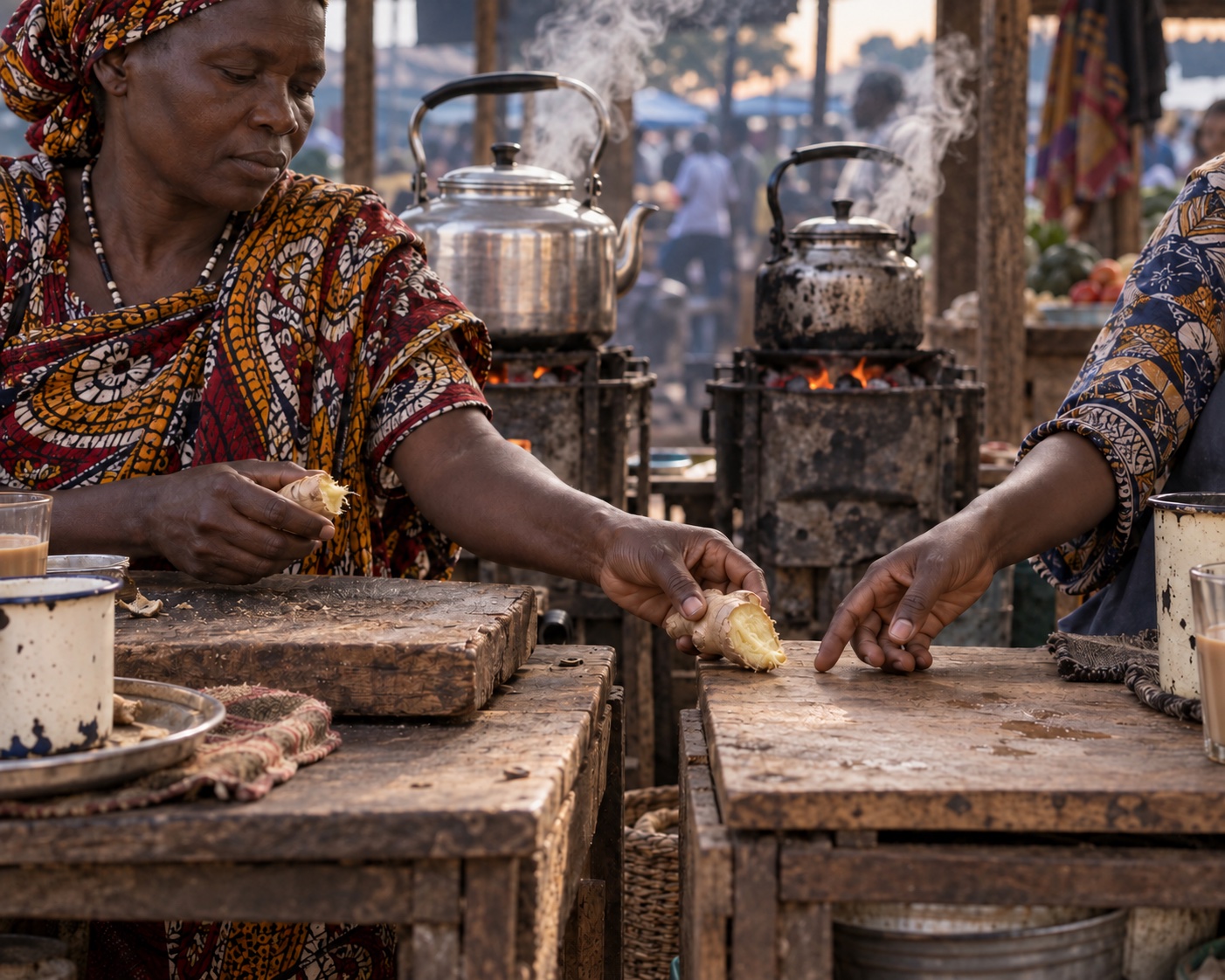
Two tea stalls on the path to Marol Market, ten feet apart, and eleven counted years of argument about sugar, ginger, and whose fire the grain men smell first. Achol’s kettle boils first. It always does. Anyone would tell you.
Achol got her fire going first, as she did every morning, as she had done every morning for eleven years, and she did not look up to check whether Nyibol had noticed. Nyibol had noticed. Nyibol noticed everything, which was the whole trouble with the woman.
The path in front of Marol Market ran from the road to the gate, and the two tea stalls stood on the same side of it, ten feet apart, so that anybody walking in passed Nyibol first and then Achol. Or, if you asked Achol, passed Nyibol and then arrived at Achol, which was the position that counted. Achol’s charcoal caught on the first match. It always caught on the first match. She set the kettle on and shook out the sugar tin and heard, beside her, the small dry scrape of Nyibol striking her own fire, late, as usual, and pretending otherwise.
“Your fire is smoking,” Achol said.
“My fire is breathing.”
“It is smoking. It is green wood and it is smoking, and when the men come they will smell it and they will come to me.”
“When the men come,” Nyibol said, “they will come to me, because your tea is sweet enough to stop a heart, and a man who has walked from Malual-chaat does not want a sweet. He wants shai.”
“He wants a sweet.”
“He wants shai.”
Neither of them was facing the other. This was normal. In eleven years they had conducted perhaps forty hours of direct eye contact and nine thousand hours of argument, and the ratio suited them both.
Nyibol’s fire took two matches. It took two matches most mornings, for reasons she did not share, one of them being that she bought the cheaper matches and the other being that she liked to have the second one ready before she struck the first.
“Two,” Achol said.
“One and a spare.”
“A spare that you struck.”
“A spare that I tested.”
Nyibol set her kettle on. It was small and it had been through things: a dent the shape of a thumb from the year the wind took it, the handle rewrapped in wire. It came to the boil faster than the big bright kettle ten feet along by a margin she had once counted under her breath at fifty-one, and she had never told Achol about the fifty-one. It would have ended the argument, and the argument was the only thing on this path that had never once let her down.
“You are behind,” Achol said.
“I am boiling.”
“You are boiling behind.”
“The kettle does not know what time it started. The kettle knows only heat. And mine knows more heat than yours, because mine is a working kettle and yours is a decoration.”
“It is a good kettle.”
“It is a wedding kettle. A kettle for a house. You bring a house kettle to a market and then you wonder.”
Achol did not wonder. She had bought that kettle in Juba with money she had counted twice in the shop and once again on the bus, and she knew exactly what she had bought, and the fact that the dented thing beside her did come up first, most mornings, was a matter she had decided years ago never to concede on any morning of her life.
The grievance, if you asked Achol, was the stones.
When Nyibol arrived on the path, arrived, as if a path were a place you could arrive at, she had moved Achol’s fire stones. A hand’s width. To make room. Without a word, on the first morning, as if the stones were nobody’s and the ground was nobody’s and a woman who had knelt in that spot for a year and a half was nobody’s either. Achol had said nothing, because she had been raised properly. She had moved the stones back, that morning and every morning for a week, until Nyibol stopped. That was the beginning, and Nyibol had started it.
The grievance, if you asked Nyibol, was the smoke.
On her first morning, before she had set a single stone, the woman beside her had built her fire on the near side of her own stall, the side toward Nyibol, so that with the wind as it usually was every breath of charcoal went straight down the row into Nyibol’s face, and had done it while looking directly at her. A fire does not wander to the near side by accident. Nyibol had said nothing, because she was new. She had built her own fire on her own near side the next morning, so that on the mornings the wind turned, Achol got it back. That was the beginning, and Achol had started it.
Neither of them had ever told the other which morning she meant. They had been careful not to. One of them was right, and it was not worth finding out which.
“How many are you expecting?” Nyibol said.
“The usual.”
“The usual is what?”
“The usual is the usual.”
“You do not know.”
“I know exactly.” Achol was measuring sugar by eye into the pot, four scoops, three more than Nyibol used and one less than Nyibol claimed she used. “Wednesdays, the grain men come early. Twenty-two. Twenty-five.”
“Eighteen.”
“Twenty-five.”
“You will make tea for twenty-five, and at nine o’clock you will pour six of them into the ground, and you will tell me you gave them away.”
This was exactly what Achol would do and exactly what she would say, and both of them knew both halves of it. Achol added a fifth scoop out of pure spite and put the lid on.
“Mabior is coming today,” Achol said.
“Mabior comes every day.”
“Mabior comes to me every day.”
“Mabior comes to whichever of us has a glass ready when he reaches the path, and on the days you are slow, which is most days, he comes to me. He has come to me since 2019.”
“He came to you in 2019 because I was at my daughter’s wedding in Anyidi and there was nobody else. That is not a customer. That is a man drinking what is there.”
“He has come to me since.”
“On the days I am at my daughter’s.”
“Your daughter has been married seven years.”
“She has troubles.”
This was true, and Nyibol knew it was true, and knew the troubles were the ordinary kind, a husband who drank and a roof that needed doing, and that Achol went to Anyidi four or five times a year to sit in that house and say nothing useful, and came back each time quieter for a day. Nyibol let the point go.
“He comes to me,” she said instead, “because my tea tastes of tea.”
“Move your tin,” Achol said.
“My tin is on my ground.”
“Your tin is over the line.”
“There is no line.”
“There is a line, and your tin is on the wrong side of it, and when the men come they will trip on it and fall in your fire, and I will have to explain to the committee why a man is burning in front of my stall.”
“In front of your stall.”
“That is what I said.”
“If he trips on my tin he falls in my fire in front of my stall, and you can go on selling your syrup to whoever is left standing.”
Achol moved the tin herself, with her foot, four inches. Nyibol watched her do it and said nothing, and moved it back three inches once Achol had turned away, and Achol heard the scrape and did not turn around, and this was as close as the two of them came to affection before six in the morning.
Achol had also seen Nyibol’s board. She had seen it the way she saw the smoke and the tin and the matches, as one more item in a case she was building and would never present. The board was bare. On Achol’s own board there was one root of ginger, and it was small.
Nyibol had run out on Monday. She had meant to go to the town market on Tuesday and had not, because her sister’s boy had a fever and somebody had to sit with him, and now it was Wednesday and the grain men were coming and she had a full kettle of what was about to be very disappointing water.
In eleven years, on the handful of mornings her board had been bare, she had taken ginger from Achol’s. Not asked. Taken, in full view, while both of them were arguing about something else. Achol had never mentioned it. Nyibol had never mentioned it. The arrangement had held for exactly as long as neither of them had said its name.
Eleven years was the count they both used. There were other years, between, that neither of them counted, when the path had been empty and the market had been empty and both of them had been elsewhere. They had come back within a month of each other and picked up the argument about the kettles where it had been left. Neither had asked the other where she had been. Neither had been asked.
One root was one root. Nyibol could see it from here.
“You are feeding it too fast,” Achol said.
“I am feeding it correctly.”
“You are putting wood on wood. You are building a bonfire under a kettle the size of a cup. It will boil, and then it will boil away, and you will have a hot kettle and a story.”
“It will boil first.”
“It will boil first because it is small. A cup boils before a pot. That is not a fast kettle. That is a small one.” She stood, and picked up the root, and broke it in two against the edge of the board with the heel of her hand, and set the larger half on Nyibol’s board, and did not stop. “Small is what you have when you cannot afford large, and you have never in your life been able to tell the difference, and that is why you think a thing that boils quickly has won.”
“It has won.”
“It has finished. Finishing is not winning.”
“Finishing first is exactly winning.” Nyibol had the half root in her hand and was grating it. “That is what the word means.”
“My mother used to say—“
“Your mother said the one about the goat and the rope. That is the only one you have. You have been dressing it in different clothes for eleven years and hoping I would not recognize it.”
“She had many sayings.”
“She had one.”
“Your kettle is boiling,” Achol said.
It was not. Nyibol looked. In the time it had taken her to grate the ginger she had stopped feeding her fire, and the small kettle had slowed, and the big bright kettle, the Juba kettle, the wedding kettle, the decoration, had come up under its lid with a sound like a held breath let go, and was, for the first time in a season, ready first.
Neither of them said so.
The men were on the path. Nyibol saw them first and did not say so, and Achol saw them a half second later and also did not say so, and both of them began the small final adjustments, the glasses set out, the lid checked, the stool nudged to the angle that made a stall look open rather than merely present.
Twenty yards up the path there were fourteen or fifteen of them, the grain men in front and two of the cattle men behind and somebody’s nephew carrying a sack he was too young for, coming on at the pace of men who have walked since before light and can now see where they are going. Not close enough to hear. Close enough to count.
Eighteen, Nyibol thought.
Twenty-five, Achol thought.
Achol lifted her kettle and poured the first glass, and the ginger was in it, both halves of one root in two pots on two boards, and Nyibol lifted hers a moment after and poured, and said, to her glasses, to the men who could not hear her yet, to the wall:
“Mine boiled first. It always does. Anyone would tell you.”
♥ 2026 Paul Titangos · CC BY 4.0 · a story from Good Day Mockingbird № 5