Issue № 6 · Story III
Off the Wall
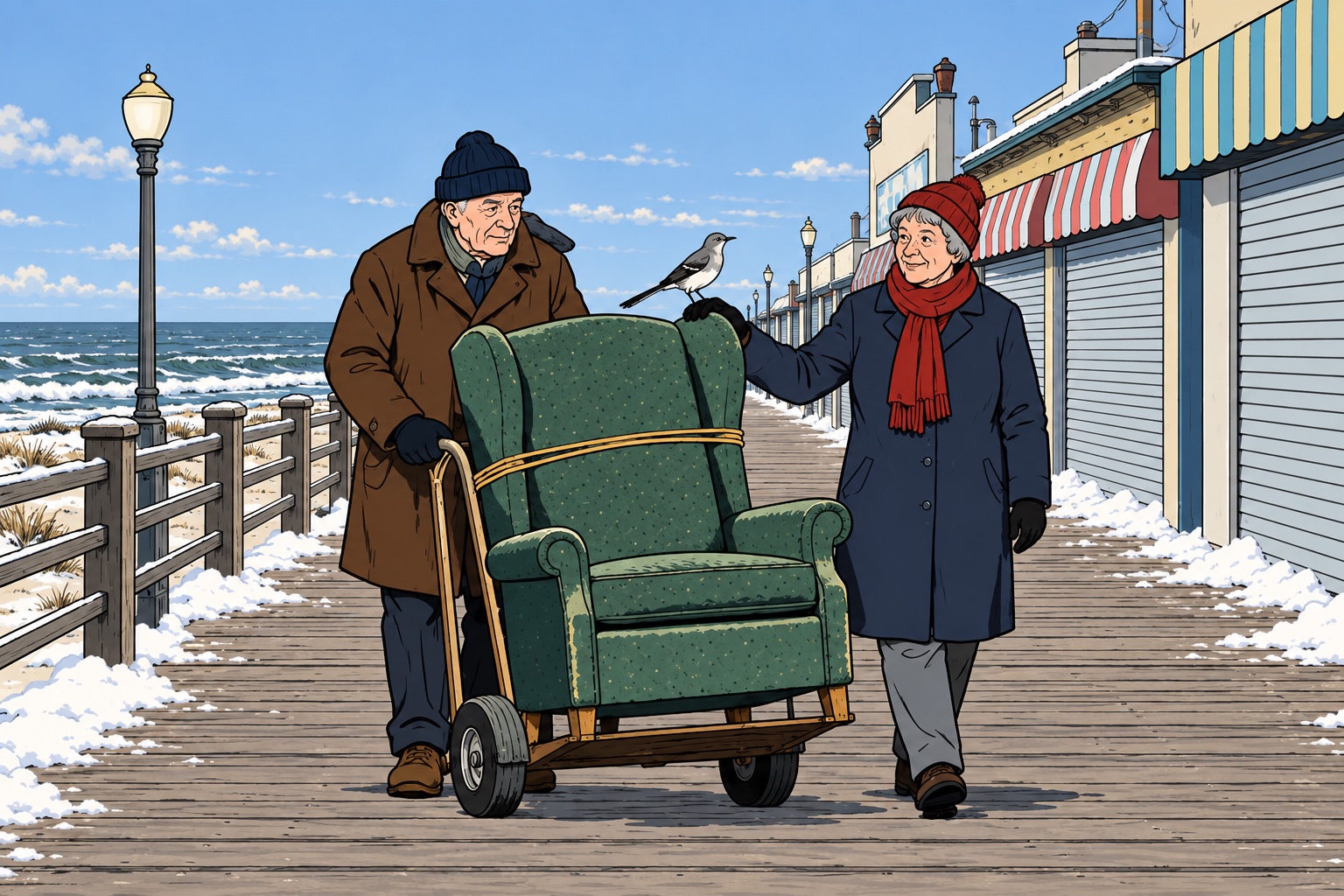
A boardwalk auction house in February 1986, shut since Columbus Day. The lunch counter next door has been dark nine days, there is a hospital bed in Rita’s front room, and Walt has a green wing chair he can’t get her to take for free.
Rita’s counter had been dark nine days, and on the tenth morning the shutter was up to the height of a man’s belt and the light was on over the grill.
Walt ducked under. She was on the stool by the register with her coat on. The coffee was already poured, in the mug with the chip, which was his. He put two quarters on the counter and she rang them and put them in the drawer, and the drawer had nothing else in it.
“My sister’s with him till nine,” she said.
“Okay.”
“What do you want for the wing chair?”
“Which?”
“You’ve got one wing chair, Walt. Green. It’s been in your window since Columbus Day.”
“A hundred and twenty-five,” he said, and heard it come out. It was the number on the card in the window. He had been saying numbers off cards since 1946 and his mouth didn’t consult him.
“I’ll look at it.”
The gallery was next door, thirty feet of boardwalk frontage with HANLON’S AUCTION — EVERY NITE 7:30 IN SEASON across the top in bulbs he took down each October and numbered. Inside it was colder than outside. The folding chairs were stacked along one wall, two hundred of them, and the floor they left was full of furniture. Winters, Walt bought out houses, the contents, from sons and daughters who drove down from offshore with a key and one weekend. By February the gallery was forty dead people’s front rooms pushed together. He had stopped seeing it some years ago, and saw it now because Rita was walking through it.
She went straight to the window and got her hands under the chair’s arms and tipped it onto its back.
“You don’t need to do that,” Walt said.
“Thirty-one years I’ve listened to you through that wall. Turn it over, folks, a chair’s like a politician, you want to see what’s underneath.” She had the dust cloth peeled back at one corner. “Those are tied springs.”
They were. Eight-way hand-tied, jute webbing, the corner blocks glued and screwed, and every joint in the frame a double dowel. Somebody in Grand Rapids had made that chair around 1948 to outlast its owner, and it had. Walt could tell you the decade of a chair from how the cloth was fixed. Before about ’55 you got tacks, cut tacks, blued, and a man’s thumbnail would tell him that in the dark. Then came staples, and the staples got thinner and brighter every ten years until by now a chair was held together with something out of a desk drawer. He had said all this once to a full house in July and watched two hundred people not care. He said it again every summer anyway. This chair had tacks.
“It’s got moth,” he said.
“Where?”
“In the back. And the seat’s crowned, that’s the springs going. It’s a thirty-dollar chair, Rita, I put a number on it for the summer people. Honest to God I’d be glad of the floor space. Take it.”
“A crowned seat is good springs. You taught the whole boardwalk that. And I’m not taking it.”
“Then thirty.”
“It says a hundred and twenty-five.”
“That’s the summer price.”
“It’s a chair. It’s not a motel.”
“Twenty,” Walt said. “I’ve got twenty, do I hear, no? Fair warning. Sold, twenty dollars, to the lady in the—“
“I didn’t bid.”
“You nodded.”
“I did not nod. You have been pulling nods off people for forty years and you’re not pulling one off me.” She stood the chair upright. Then she opened her purse and started counting twenties onto the podium. She lost her place at eighty and stood there with a bill in her hand, and gathered them all up and began again, slower, and put a five on top. “You told me once there’s not a seller living who can watch money counted out in front of him and say no.”
He looked at the money. He had counted it along with her, both times. He couldn’t not.
He had taken money from widows. He had taken it from a priest, for a set of golf clubs, and run the priest up first. Taking it was the one thing he was sure he knew how to do. But he had watched the hospital bed go in, ten days back, two men and a van with a lift gate. He knew the front room of that house, and he knew there was nothing in it now to sit on but what she’d carried in from the kitchen.
“How’s Sal?”
“He’s dying, Walt. How do you think he is?”
The gallery was quiet enough to hear the bulbs in the window tick.
“Asleep, mostly,” she said. “Yesterday he asked was it the season yet.”
Walt had never much liked Sal. Sal was loud. He parked his van across the gallery’s freight door every July as if he held it by treaty, and on slow nights he’d sit in the third row with a lemon ice and say “Who died?” at every piece of furniture that came up, and get the laugh. The van had not moved since Thanksgiving. There was sand drifted against the tires.
“Tell him—“ Walt said, and found there was no end to the sentence. Rita waited for it politely.
“Tell him it isn’t,” he said.
Neither of them touched the money. Rita had never in thirty-one years let him leave a penny on her counter that wasn’t owed, or walk off owing one. The week after the storm, with a foot of bay water in both their places and the power out to the bridge, she had run the grill off a generator and charged him fifteen cents for his coffee, and he had never in his life been so glad to pay for something. Nobody owed anybody. That was how it was done, and he could see no way to get a chair through it except one, and he had been hoping to die first.
“The lamp,” he said.
Rita looked at him.
“August of ’56. The ginger-jar lamp, the blue one. You had it at twelve and I walked you to twenty-four. There wasn’t anybody bidding against you. I took it off the wall. Twice.”
“Three times,” Rita said. “Fourteen, eighteen, twenty-one.”
“You knew?”
“I turned around, Walt. There was nobody behind me but a gumball machine.” Her voice had gone up. “I was thirty-four years old and I stood there with my hand in the air like a fool and you looked right at me and took another three dollars. I didn’t even like the lamp. I’ve had to dust it for thirty years.”
“You never said.”
“You were going to be there Tuesday. So was I.” She shut her purse. “You do that to the shoobies. They go home Sunday. I thought, he must have had a bad week. And then I thought, no. He just can’t help it.”
He had nothing to put against that, and didn’t try.
“So I owe you,” he said.
“You owe me twelve dollars.”
“With interest.”
“Oh, for God’s sake.”
But he was already behind the podium, where the calculator lived, the big Sharp with the paper tape, and he keyed in twelve. “Thirty years. What’s Visa get, eighteen?” He ran it out, thirty times, and tore the tape and looked. “Seventeen hundred and twenty dollars.”
Rita laughed. It came out of her like something dropped, and she put her hand over her mouth.
“For a lamp,” she said.
“It was a nice lamp.”
“It was not. Three percent. That’s what the bank paid.”
“I’m not a bank. I’m a guy who robbed you.”
“Three.”
“That’s twenty-nine dollars, Rita, I can do threes in my head. Twelve.”
“Four.”
“Ten. It’s a junk chair.”
“It’s a hundred-dollar chair and you know it. Five.”
She looked at the clock over the door, the one that ran all winter because nobody had ever thought to stop it. Twenty of nine. He watched her do something in her head, her lips moving on it.
“Seven,” Rita said. “And that’s a ninety-dollar chair. Off-season.”
“Seven.”
He cleared the machine. And because his hands were on the keys and her eyes were on him and there was a number to be got to, his voice dropped into the chant. He hadn’t asked it to.
“Twelve dollars, I have twelve. Fifty-seven, twelve eighty-four. Fifty-eight, thirteen seventy-four. Fifty-nine, fourteen seventy, fifteen seventy-three, do I hear sixteen, sixteen eighty-three and it’s nineteen sixty-one—“
He called her through the awning Sal hung in ’75 and the summer the beach tags came in and nobody came. At sixty-two, eighteen oh one, his voice caught, and he rode over it, because you never let a room hear you stumble. At forty dollars she sat down on the arm of some dead man’s sofa with her coat pulled round her and watched him work. She had never seen it from the front. Thirty-one years, and she’d only ever had it through the wall.
“Eighty-five thirty-seven, I have eighty-five, and eighty-six, last call, fair warning—“ He hit the key. “Ninety-one dollars and thirty-five cents, to the lady on the sofa.”
He tore the tape and handed it across. She read it top to bottom, all thirty lines, because she was not a person who signed for a total.
“You’re a dollar thirty-five over,” she said.
“I know what I am.”
She picked her twenties up off the wood and counted them back into her purse, and the five.
He got the chair onto the hand truck and ran a strap around it. She walked beside him with one hand flat on the top rail, down the ramp at Twelfth and along Atlantic with the wind behind them. Her sister’s Buick was still at the curb, behind the van. He tipped the chair off on the porch and she said she had it from there, and she did. She walked it in through the door one leg at a time.
In the morning the shutter was up to his belt. He put two quarters on the counter and she rang them. He put a dollar thirty-five down beside them, the thirty-five in nickels, and she pushed that back across to him. She took a guest check off the pad and wrote WALT at the top, and under it 1.35, and stuck it on the spike.
By Easter it said he owed her three dollars. The Tuesday after the funeral it said she owed him sixty cents.
♥ 2026 Pete Kaminski · CC BY 4.0 · a story from Good Day Mockingbird № 6