Issue № 6 · Story II
Out of the Set
A covered market on the Catalan coast, shut since November and let out in the dead months to a wedding-photo crew from Seoul. Sixty euros for the morning, rented resin lemons on a marble counter that has weighed thirty-two years of real ones, and a crate of cherries that won’t last till noon.
The call sheet said 07:30 and Rosalía was at the service door at ten past seven, because a call sheet is a delivery time and she had never in her life been late for a delivery.
The hall had been shut since the first of November. She came in twice a week anyway to run the taps at her parada and check the chiller she left switched off, and she knew the building in winter better than she knew it in August, when there were people in it and you could not see the floor. In winter you could see the floor. Concrete, painted grey in 1986 and repainted grey twice since, and a drain at the low end that stayed dry all winter and held its smell anyway.
Twenty-three concessions. Six of them still had somebody coming in. The other seventeen were papered over on the gallery side with the association’s notices from October. The notices had curled.
The association had begun letting the hall out in the dead months, because the dead months had to be paid for. The supermarket in the basement had written twice about the floor. There was a vote in March. The six of them knew what four days like this one came to across a winter, set against what the floor was worth to a chain, and none of the six had said it out loud since October.
She put her lights on. The strip above her counter came up in three stages, the way it had since the ballast went. The girl with the clipboard came down the aisle at a trot and asked her, politely, in Spanish, whether the lights could go off again.
“They are my lights.”
“We’re bringing our own. It’s for the colour.” The girl was maybe twenty-six and had a lanyard and a radio and a printed schedule folded to a rectangle the size of a hand. “It’s just that yours are green.”
They were green. Rosalía had known they were green for thirty-two years. She turned them off. What was left was the light off the glass at the station end and the light coming up the escalator from the basement, where the supermarket had the only heating in the building and opened at eight even in winter, whatever the hall was doing.
They had built the stall for her before she arrived.
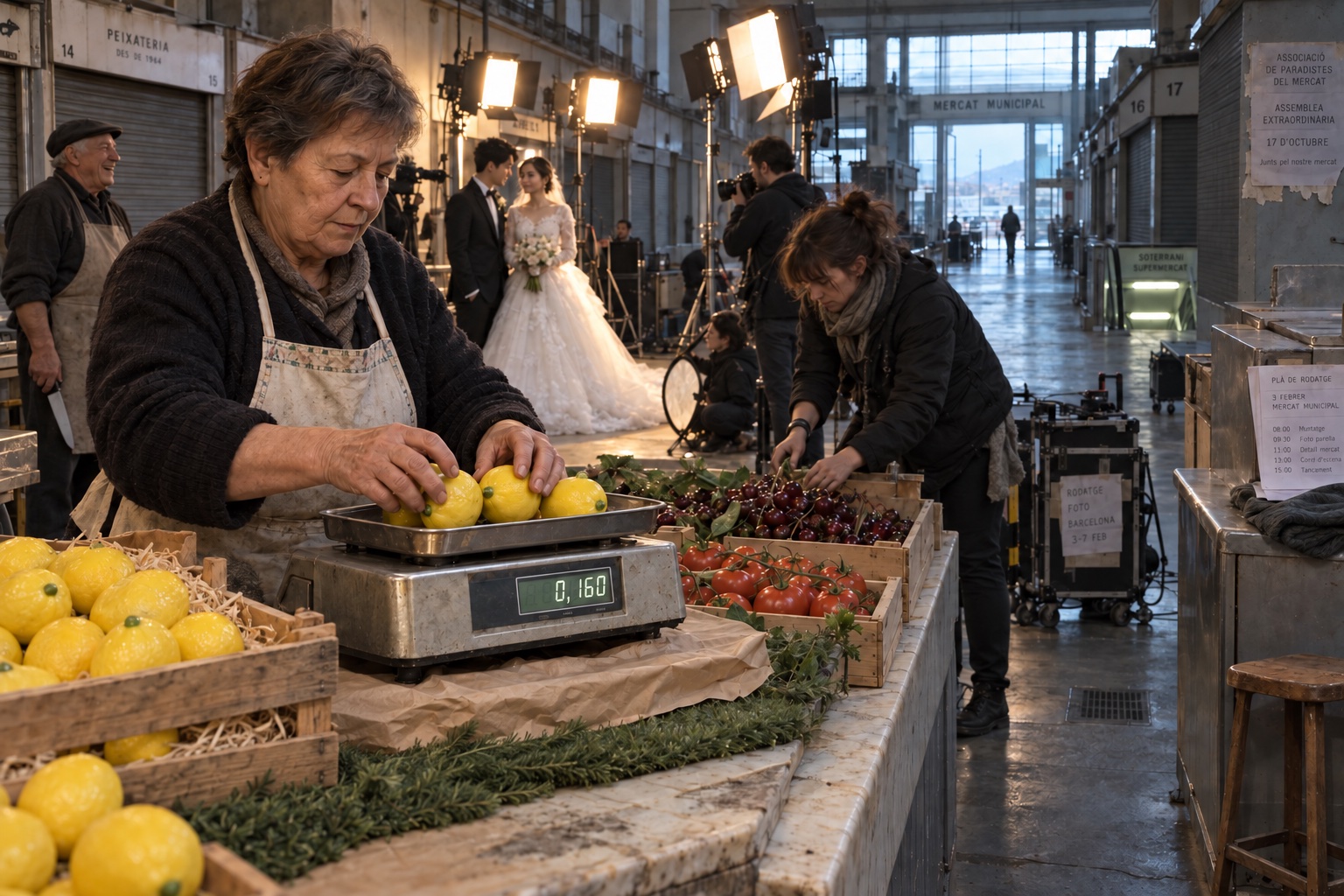
That was the thing she had not expected. Her own counter, the marble she had inherited with the concession, was there under it all, and on top of it they had laid a slatted crate front and a length of grass matting and a run of paper the colour of straw. Her scales had been moved to the side and turned to face the aisle. A woman of about thirty-five, in a padded jacket over a jumper over a shirt, was setting fruit into the crates by hand, one piece at a time. She turned each one before she left it.
“Buenos días,” the woman said. “Núria. You’re Rosalía.” She did not stop turning fruit. “I’m going to keep you until one. There’s coffee in the flight case by the escalator, it’s not good.”
Rosalía looked at the fruit.
Lemons, twenty-four of them, in two crates. A shallow tray of oranges. A crate of tomatoes on the vine. Every lemon had the same bloom on the shoulder and the same green at the stalk end, and not one of them had a mark.
She picked one up. It weighed nothing. It weighed perhaps forty grams, and a lemon of that calibre weighs a hundred and thirty, and the surface under her thumb had the small tack that comes off a mould.
“They’re rented,” Núria said. “Four figures for the day with the crates, don’t ask me, it’s not my line.” She turned a tomato stalk-up and set it down. “The tomatoes are real, we couldn’t get anything fake in the vine, and the cherries are real. Everything on this counter is in the set. Nobody eats anything in the set.”
There were cherries.
There were cherries in February in a crate at the front of the display, which is where a trader puts the thing that makes people stop, and Rosalía did the arithmetic that she did not have to do because she had done it every February of her working life. Chile. Air freight. Barcelona wholesale on a Tuesday, sixteen or eighteen a kilo now, half what they had made at Christmas, because these were the end of the season and had come a long way to be the end of it. Four kilos in that crate, and they would not last a day under a lamp. She said nothing. Núria had not touched a single piece twice.
At half past eight the others came in. Bernat, who had the poultry and was seventy-six and had not worked a Saturday since his wife died. The Aymerich brother, the younger one. Fina from the eggs and the dried fruit, who had not been chosen and had come anyway. She stood at the top of the aisle with her arms folded for an hour and a half, saying things to nobody in particular.
Sixty euros each, the girl with the clipboard had said on the telephone in January. Sixty for the morning, and lunch.
The couple came at nine.
They were from Seoul. Rosalía got this from the producer, who got it from nowhere, because nobody in the crew spoke to them except through a young man who travelled with them and had no other job. The bride had been married in October. This was not the wedding. This was the pictures, taken afterwards, in Europe, in a dress carried in a bag the size of a mattress, and the pictures would be captioned Barcelona. Barcelona was forty minutes up the line.
For three hours the market was lit from four stands and a reflector held by a boy who lay on the floor to hold it. The hall was warmer than it had been since October. The lamps made the grey concrete look like stone.
Rosalía’s instruction was to weigh.
“Just the hands,” Núria said. “You put the lemons on the scale, you take them off, you put them on. Don’t look at the camera. Don’t look at them. Look at what you’re doing.”
So she looked at what she was doing. She put four rented lemons on a plate that had weighed out something over a thousand tonnes of other people’s dinners, and the display gave her 0,160, and four lemons of that calibre are five hundred and twenty grams. She took them off and set them back and did it again. Nine times. Eleven. She lost count somewhere after the second setup and stopped counting, and that was the first time in the morning she noticed anything about herself.
They kept Bernat for longer.
He was supposed to stand behind the poultry and hold a knife and not use it. What he did instead was talk. He talked at the couple in Catalan, which they did not have, and he laughed at his own line, and the bride laughed because he had laughed, and the photographer said something in English and everybody moved two steps to the left and did it again. They took Bernat for forty minutes. They took him with the knife and without the knife and with his hand up. At one point he put his cap on the bride’s head. The producer wrote something down.
He was good. Rosalía watched him be good from ten metres away with four lemons in her hand, and she could see exactly what he was doing, and she could not have done it, and she had never wanted to and did not want to now, and none of that made any difference to the fact of it.
Núria came down the aisle with a card and a marker.
“Can you write the price? For the lemons. In your handwriting.”
That was a job. Rosalía took the card and the marker and did the job. She wrote the name of the fruit, and under it the origin, and under that the category, and last the price by the kilo, in the hand she had used on every card in that stall since 1994, the figures upright and the decimal a comma and the euro sign after the number, where it belongs.
LLIMONES
Espanya · Múrcia
Categoria I
2,45 €/kg
She propped it against the crate at the angle that lets a person read it from the aisle without stopping.
Núria looked at it for slightly longer than she needed to.
“It’s beautiful,” she said. “It’s too much text. At that distance it reads as a paragraph, it’ll pull the eye off her hands.” She was already lifting it away, and she was right, it would.
The prop card went up. It was cream and had been lettered by somebody in Barcelona with a brush, one word, and the word was LIMONES, and beneath it a numeral with no kilo after it, so that the fruit cost three euro fifty of nothing at all. Rosalía read it from the aisle side and left it where it was. Somebody had spent money on that card.
The last setup was the wide one. She had it from the producer’s watch and from the way he kept looking at the far end of the aisle, where they had run the straw paper down three empty counters to make the market look like a market. It was the shot the day was for. It was scheduled last.
The cherries had been under two of the lamps since half past nine.
She could see what was coming from where she stood, and it was not a judgement, it was a date. They had come off a tree in Chile at the tail of a season that finishes in January. Three weeks in a container, two days on a counter. Sound now, at half past ten, at the front of the crate with the light on them. By noon the shoulders would go dull and the stalks would brown and they would sit in the shot looking like exactly what they were.
Nobody else in the building could see it. That was not pride. Fina could have seen it. Bernat could not, because poultry is another trade. The crew could not, because to the crew fruit was red or it was not red.
She could say it or she could weigh lemons.
If she said nothing, the wide shot would be taken at noon with turned fruit across the front of it, and it would be found in the edit, or in Seoul, or never, and nobody in this hall or any other would ever put it next to her. She would have stood at her own counter for four hours doing what she was told. That was one available version of the morning. She had been told to look at what she was doing.
She waited until Núria came past with the empty tray.
“The cherries won’t hold,” Rosalía said. “Not till noon. Take them out of the light and put the vine at the front.”
Núria stopped. “How long have I got?”
“An hour. Less at four lamps.”
“Out of the set, then.” She said thank you once, and moved the crate herself, and put the tomatoes where the cherries had been, so that the front of the display went from red to red. At twelve they took the wide shot and it was clean.
Fina had gone at ten and had come back, which nobody remarked on, because there was nowhere else in the town to be at noon in February. She came down as far as the Aymerich counter and stood where she could see the front of the display. She looked at it, then at Rosalía.
“Those wouldn’t have held,” she said.
“No.”
“I saw you tell her.”
She went back to the top of the aisle.
They wrapped at one.
The lamps came off their stands in ninety seconds. The matting came up, and her marble was her marble again with the scales facing the wrong way. She turned the scales back.
The producer took them one at a time at the escalator, with a folder of printed names and a box to sign. He copied each of their NIF numbers in by hand. Sixty, by transfer, thirty days. Rosalía stood behind Bernat in the line with her NIF out of her purse and her thumb over the number, close enough to hand it across when he moved. Bernat signed and stayed talking, and the producer said something to him about the spring, about coming back for the spring shoot, they’d be back the second week of April, they’d ask for him. Bernat said of course, of course, and did not look round to see who had heard.
The producer took her card and copied the number and thanked her and said the transfer would be the fifteenth.
Núria was breaking down the fruit crates. The tomatoes and the cherries went into a plastic sack for the crew, and the resin lemons went back into their fitted foam in their own case, all twenty-four. Beside the case was a shallow tray of seconds. She looked up.
“Do you want these? Not those. These.” Two lemons and an orange in her hand, the seconds, the ones with the mould line down the side that the camera would have found. “They’re binning them. They’re out of the set.”
Rosalía said yes, because it was easier than the other thing.
She locked her chiller and killed her lights and let herself out of the service door at twenty past one into the cold, and the hall behind her went back to being what it had been since November. Four hundred metres up the Passeig there was nobody on the beach and nobody on the terraces and both the kiosks were boarded. The town would come back in April. It always came back in April.
At home she put the two lemons and the orange in the bowl on the table where the fruit goes. Somebody upstairs was running a bath.
They sat above the line of the rim, yellow and yellow and orange. They would hold their colour for as long as she kept the bowl, because there was nothing in them to turn, and she went to wash her hands.
♥ 2026 Paul Titangos · CC BY 4.0 · a story from Good Day Mockingbird № 6