Issue № 13 · Story II
Mgongo Wazi
Kisumu, October 2003. Otieno has filleted Nile perch at table seven for nine years, and he leaves a finger’s width of meat on every frame that goes out over the wall, where the women from Obunga buy the skeletons by the kilo to fry. They ask for his table by number. Then a fax comes from Osaka about fillets running thin along the back, and a new supervisor puts a scale at the end of the line.
Kisumu, a fish plant near the lake, a week in October, 2003.
The fish came in before it was light, in insulated trucks off the beaches, two and three days’ buying packed in layers with ice between, and the plant’s own selectors went through them again at the door. Anything with a yellow gill or a belly that stayed dented under the thumb went back on the agent’s account. The rest went onto the line, and the line was thirty men in white coats and white boots at steel tables, with the chlorine bath at the door that you walked through whether your boots were clean or not.
Otieno had table seven. He had had it for six of his nine years, since the man before him went to the plant in Homa Bay and never came back, and he kept two knives on it, a long one and a short one, and a steel that he did not let anyone else touch.
A perch came to him on its side, the size of a small boy’s leg, cold, and smelling of nothing yet, because the selectors were good. He put the short knife in behind the gill plate and drew it down to the backbone and stopped there, at the bone, where he could feel it. Then he turned the long knife flat and ran it from the head to the tail along the spine, over the ribs, in one draw, and the side came away in his left hand, and he laid it on the tray skin down. This week was for Japan, so the skin stayed on. Next week might be America, and then Mary at the next table would skin them with a knife and a board before the trim.
He turned the fish and did the other side.
That was the whole of the cut, and there was nothing in it, except that a long knife held flat against a backbone can be held a little flat or a little less flat. The difference was the thickness of a matchbox. Along the top of the spine there was a dark strip that was mostly fat and the best of the fish, and between the ribs there was meat that a careful knife could take and a careless knife would leave, and at the collar there was a fist of meat that the plant had started selling separately to a trader who drove it to Mombasa. Otieno was not careless. He knew where every gram was, and he left some of it, along the spine, between the ribs, a finger’s width on every frame, and he had done it for long enough that it was no longer a thing he decided. It was what his hands did.
The frames went into a blue bin under the table, and when the bin was full a boy took it on a trolley out the back, through the yard and the gate in the wall. The wall was new, three years new, tall concrete with glass in the top. Men from the importers’ side had walked through the plant with clipboards and said skeletons could not stand inside the building near the fillets, so the plant had built the wall and sold the skeletons over it, as fast as they came off the knives, and nobody had to think about where they went.
They went to the women. When the shift came off, there were forty of them at the gate with basins and sacks and a few with handcarts, and Onyango stood at the scale with a book and a tin box, and weighed out frames at a shilling fifty a kilo, skins at a shilling, guts by the bucket for the fat. In Obunga they would hang the frames on wire to dry for a day, render the guts down in a cut drum, burn the skins under it, and fry the frames in their own fat, and sell them in the evening by the kilo to people who could not buy a fish. Mgongo wazi, people called them. Open back. You could see through them to the ground.
Onyango sold table seven’s bin separately. He did not say so, and he did not write it in the book, but the women knew which trolley it came out on, and a woman who wanted it paid him a shilling more for the sack, into his hand and not the tin.
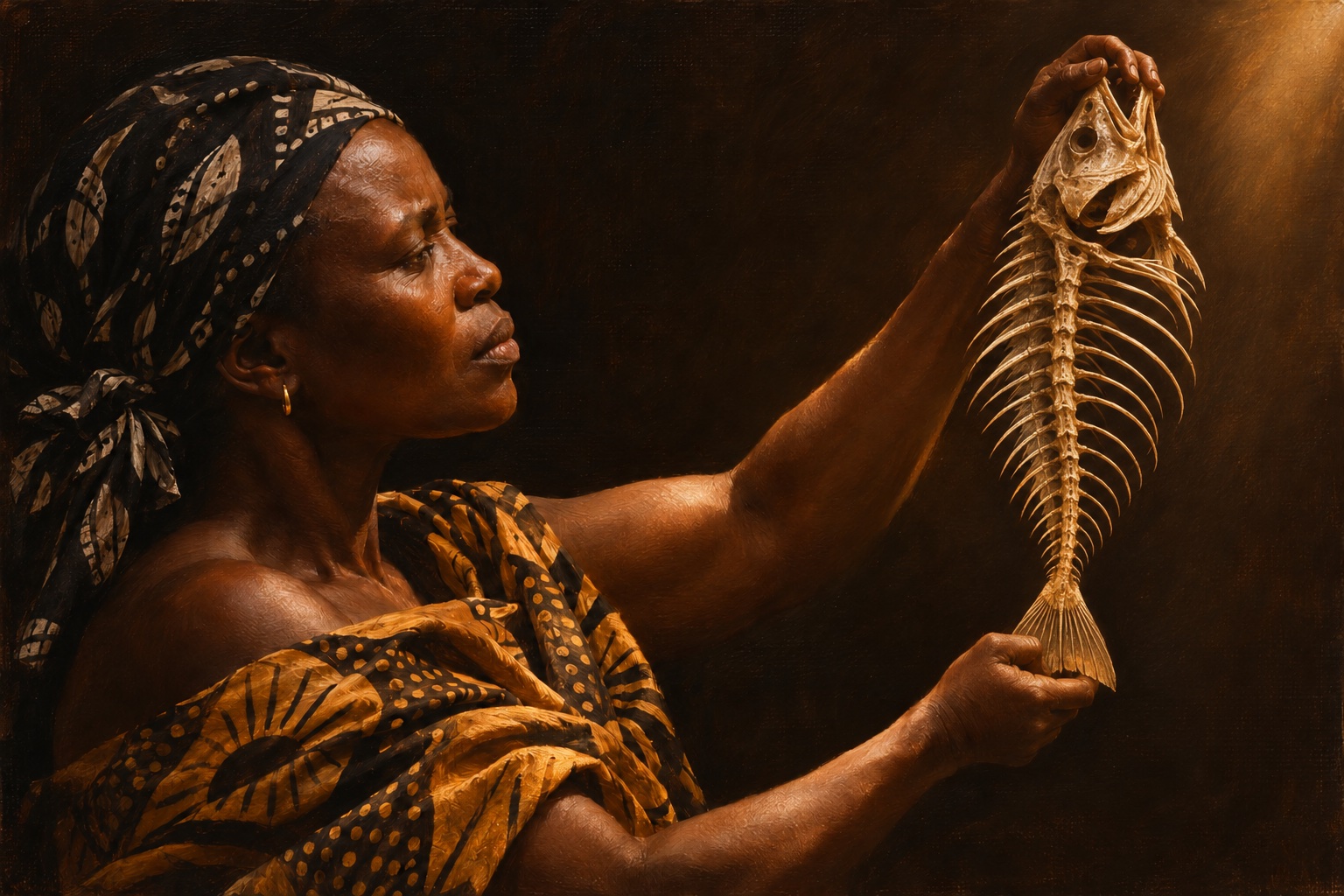
Akoth usually got it. She was a widow from behind the Obunga market, in a headscarf the colour of ink, and she had been at the gate since before the wall, and she had a way of standing at the front without having pushed.
“Seven,” she said to Otieno when he came out, as she said it most days, and took hold of the sack.
He nodded to her and went for the matatu. It was the best part of the day, walking past the gate with his own table’s number in somebody’s mouth.
The scale was there on Monday, a platform scale with a dial, at the end of the line where the trolleys went out, and on the wall above it a blackboard with the table numbers painted down the side.
Ouma had been supervisor for five weeks. He was twenty-six and had a diploma from the polytechnic and a white coat that was whiter than anyone’s, and he was polite to the men on the line in a way that made the older ones uneasy. He had a fax in a plastic sleeve, and at the ten o’clock break he brought it to table seven and laid it on the steel, out of the wet.
It was from the trading house in Osaka that took the skin-on fillet. It was in English, courteous, and very exact. Over the last four containers, it said, a proportion of the fillets packed as the 1,000-to-2,000-gram grade had weighed out short on arrival, and the fillets in question were noticeably thin along the dorsal side. The trading house was sure that the plant would wish to investigate. A copy had gone to the managing director.
Otieno read it twice.
“Every bin gets weighed now before it goes out,” Ouma said. “Frames, by table. Fish in, by table. Then we know the out-turn for each table.” He had a stub of chalk in his breast pocket and took it out and turned it over. “Last week the plant was at thirty-eight. That’s not bad. Japan says we’re short in the grade, so it’s somewhere. Saturday I weighed the bins and nobody knew why I was weighing.”
He went to the board. Next to each number he had written a figure from Saturday, and the figures ran from thirty-seven to forty, except at the seventh line, where it said thirty-four.
“I’m not saying you’re slow,” Ouma said. “You’re the fastest on the line. Everybody tells me.”
“I’m not slow.”
“No. So I think it’s the spine.” He said it without any accusation in it. “Four points, Otieno. Your table runs seven hundred kilos of fish a shift. Four points of that is twenty-eight kilos of fillet. Japan pays three dollars a kilo, so that’s eighty-four dollars, every day, six days a week. And we sell it at the gate for forty-two shillings.”
“It’s not going out like that,” Otieno said. “It’s still on the bone.”
“It goes out with the bone.” Ouma put the chalk back in his pocket. “I’m not going to write anybody up. I’m asking you.”
Otieno looked down the line. The men at six and eight were listening and pretending not to.
“I can cut it,” he said.
“I know you can,” Ouma said, and took his fax back.
He knew exactly where it was. Afterwards, that was what he thought about. He did not have to look for it. He had been putting it there.
On Tuesday he held the long knife flat against the spine, all the way flat, and took the dark strip with the fillet, and took the meat between the ribs with the short knife after, and the frames went into the bin pale and thin and clean as something drawn on paper.
It cost him nothing. That surprised him a little. He had thought there would be some resistance in his hands, a habit to fight, and there was none; it was a different angle, and a better one, and by the third fish his hands had it. The fillets on his tray sat up thick along the back. Mary, at the next table, picked one up to move it and put it down again and looked at him and did not say anything.
At the end of the shift the bins went over the scale, and Ouma wrote on the board, and on Wednesday morning table seven said thirty-nine. On Thursday it said forty-one, and was the highest number on the wall.
Ouma did not say anything about it in front of the line. He came at the ten o’clock break and asked whether Otieno would show the new men at the far end how he took the spine, the two from Bondo who had come in September, and Otieno said he would, and stood behind them for an hour with his hands on theirs. They learned it in a morning. It was not difficult. It was only a matter of somebody wanting it done.
By Friday the numbers on the board were close together, thirty-nine and forty and forty-one, all the way down. Otieno looked at them on his way out and found that he was pleased. It was a good board. His number was at the top of it.
At the gate the frames came out of the trolleys and went over Onyango’s scale, and the women stood over them with their basins, and there was a noise among them that he had not heard before, low, not angry yet.
Onyango was not selling table seven separately any more. He had stopped on Wednesday. There was no reason to pay a shilling for one trolley over another, and the women had seen that before he had.
Akoth had a frame up in both hands, by the head and the tail, and was holding it against the light so the sun came through between the ribs. She turned it over and looked at the other side. Then she saw him.
“Seven,” she said. “What happened to seven?”
He could have said the fish were small this week. Some weeks they were.
“They weigh the frames now,” he said. “Before they come out.”
She looked at him for a moment longer, and then she put the frame in her basin with the others and pushed the basin across to Onyango.
“A shilling,” Akoth said. Onyango put it on the scale, read the dial and wrote it in the book.
He charged her a shilling fifty a kilo, the same as on Monday.
♥ 2026 Pete Kaminski · CC BY 4.0 · a story from Good Day Mockingbird № 13