Issue № 3 · Story II
Margin Notes
Sixty years of strangers arguing in the margins of a two-dollar Persuasion. Frankie reads for the audience, falls for Red, and traces the blue ink home.
The book cost two dollars, a hardback the color of old butter with the spine sunned down to no color at all, and Frankie bought it because she had loved Persuasion at nineteen and lost her copy somewhere between apartments, the way you do. She didn’t open it until she got home. If she had opened it at the stall she’d have paid twenty.
Three people had gotten there before her.
The oldest hand was pencil, faint and upright, a hand that had been taught penmanship by someone with a ruler. The second was blue fountain ink, loopy and warm, taking the corners of pages like a car with the windows down. The third was red felt-tip, blunt and quick, a hand that pressed hard and abbreviated everything. Sixty years, give or take, in three inks, all of them talking. None of them, as far as Frankie could tell, had ever met.
Pencil got there first and set the tone, which was dry as a good martini. On the first page, beside Sir Walter Elliot admiring his own entry in the Baronetage, Pencil had written, every town has one. Beside Lady Russell persuading Anne to give up her sailor, Pencil wrote, she should have held firm, and pressed the period in like a thumbtack.
Blue arrived maybe twenty years later and answered as if no time had passed at all. Under she should have held firm, in that warm loopy hand, Blue had written, she was nineteen and everyone she trusted told her to. Be kind. Blue underlined constantly, effusively, sometimes twice. Blue wrote oh no in three places and oh THANK GOD in one. The two of them fought a running battle over Captain Wentworth. Pencil called him proud, and twenty years later Blue wrote, proud is what hurt people do instead of crying, and Pencil, being decades gone, had no answer to that. Frankie found herself keeping score anyway. It was the strangest kind of eavesdropping, two strangers debating with a wall of years between them, and the wall never once winning.
Red came last and argued with both of them. Where Pencil corrected and Blue defended, Red heckled. At Louisa Musgrove jumping off the steps at Lyme, Red wrote, this is why we can’t have nice men. At one of Pencil’s sterner verdicts, Red wrote, Pencil, I would have gotten coffee with you. You mean old knife.
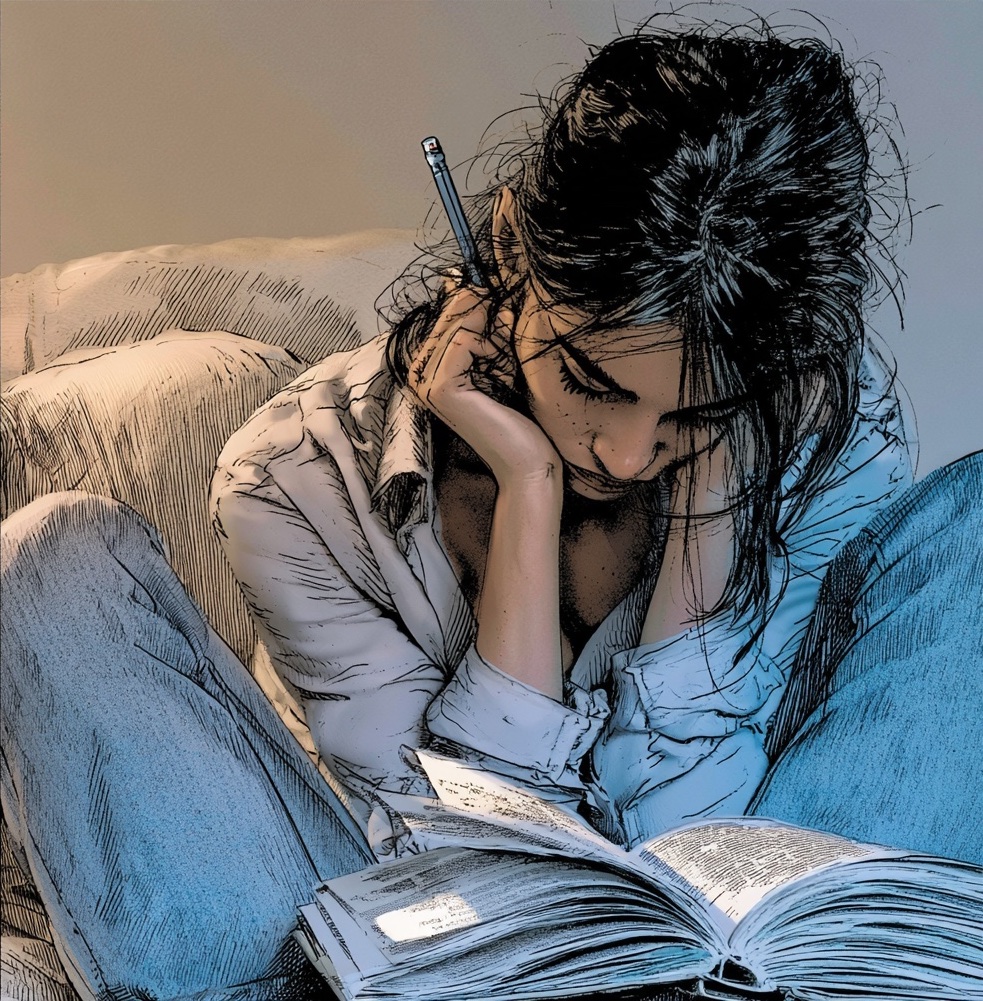
Frankie read the novel and the marginalia together, the way you’d watch a play and its audience at once, and somewhere around the third evening she admitted she was reading for the audience.
It was Red. Of course it was Red. Pencil was brilliant and Blue was kind, but Red was alive on the page in a way that made the ink feel wet. Red was funny the way people are funny when the alternative is unacceptable. And on page sixty-one, beside a scene where Anne sits unnoticed in a room full of people discussing her, Red had written something that stopped Frankie’s tea halfway to her mouth.
Blue had written, decades earlier, poor girl. Nobody in this book listens to her.
Under it, Red: you’re both talking to a dead woman. (So am I.)
Frankie sat with that a long time. She decided it was wit, the gallows kind, and kept reading, and was wrong, and found out she was wrong at one in the morning at Chapter Twenty-Three, which is where Persuasion keeps the letter.
You know the letter even if you don’t. Wentworth, eight years too late and just in time, writing to Anne with half the room watching. Pencil, who had had something to say about everything for four hundred pages, had gone silent there. Just one vertical line beside the paragraph, pressed so hard it grooved the next three pages, which from Pencil was a scream. Blue had underlined half agony, half hope twice and written, he waited EIGHT YEARS, the capitals wobbling.
And Red, in that blunt felt-tip, had written in the bottom margin, not to the book at all.
Mom. Did anyone ever write to you like this? I hope somebody wrote to you like this.
Frankie put the book down on the quilt and looked at the ceiling for a while.
Blue was Mom. Blue, with the warm loops and the double underlines, had died, and the book had gone to a daughter who answered her in the margins because the margins were where her mother still had a voice. Sixty years of strangers arguing in a two-dollar book, and the two youngest hands were a conversation between a girl and a mother she could not otherwise reach. Without ever meeting. Or, meeting only here, in the white space around somebody else’s love story.
Frankie worked the interlibrary loan desk at the county library, which is to say that finding things that had wandered was her actual profession, and by morning the feeling in her chest had converted itself into method.
She started at the stall. The woman who ran it kept no receipts but total recall, and told her the book had come in a box lot that spring, a storage-unit clearance off Delft Street, mostly books and a bread machine. The storage company gave up nothing until Frankie mentioned the auction, and the auction house, which posted its liquidations publicly, gave up everything. Unit 214. Contents sold for nonpayment. The name on the lapsed lease was Daniel Abbott.
Daniel Abbott, when she found him, was a tired-sounding man in Ohio who took a long breath when she described the book.
“Those were Marnie’s,” he said. “My ex-wife. The unit was supposed to be temporary, during the divorce, and then I moved, and I let it go. I told myself it was mostly my stuff in there.” A pause. “It wasn’t.”
“The annotations,” Frankie said. “The blue ink.”
“Her mother. Edie. Died when Marnie was a year and a half. Marnie used to say the marginalia was the only place her mom had a speaking part.” He gave her a number. He asked, before he hung up, that Frankie not mention his name, and then said never mind, mention it, and hung up before she could ask which.
Frankie looked at the number for two days. There is no casual way to call a stranger and say, I have your dead mother’s handwriting, also I know your marriage ended at auction, also I may be a little in love with your teenage margins. On the third day she texted a photograph instead. Page sixty-one. You’re both talking to a dead woman. (So am I.)
The reply came in forty seconds. Where are you.
They met at a coffee place halfway, and Marnie Abbott turned out to be about forty, with fast hands and a laugh she deployed like a doorstop, something to keep certain rooms from closing. Frankie slid the book across the table and watched her not touch it for a full minute, the way you’d stand at a door you had knocked on for years after you’d stopped expecting it to open.
Then she opened it, and did the thing Frankie will be describing to people for the rest of her life. She didn’t flip to the letter. She went to the front, to Pencil’s first crack about Sir Walter, and she read the whole provenance in order, the way you’d walk a property line. Every town has one. She was nineteen. Be kind. You mean old knife. Her lips moved a little on the blue ones.
“I was fifteen,” she said, at the felt-tip. “I thought I was hilarious.”
“You were hilarious.”
“I was talking to her.” Marnie kept her eyes on the page. “Dad couldn’t. Talk about her. So I’d read her margins and answer them, and it was the only conversation we ever got to have, and she’s funnier than me, which is very annoying, because she’s been dead thirty-eight years and she still gets the better lines.” She turned a page. “Then I lost the whole conversation in a storage unit because I couldn’t look at boxes.”
“You didn’t lose it,” Frankie said. “It just circulated.”
Somewhere past the middle of the book Marnie stopped and went still, and Frankie knew which page it was without looking, because there was a fourth hand in the book now.
Frankie had held out for a hundred pages, that first week, and then given in the way all of them must have given in, because a margin is an invitation with the date left blank. She’d used pencil. It had felt polite, using the oldest instrument, like taking the smallest chair. She had answered Red’s jokes, mostly. Argued once. And beside the letter in Chapter Twenty-Three, under Mom, did anyone ever write to you like this, Frankie had written the only thing she’d had at one in the morning, which was, somebody is going to. I realize this is a strange thing to promise a margin.
Marnie read it twice. Frankie watched her do the thing she herself had done for a week, watched her build a person out of a handwriting, and had the strange vertiginous experience of being on the other side of it, of being somebody’s marginalia.
“You argued with me,” Marnie said. “Chapter Ten.”
“You were wrong in Chapter Ten.”
“I was fifteen in Chapter Ten.” She laughed the doorstop laugh, and this time it held a door open instead. She looked down at the four hands crowding the bottom of the letter, sixty years of strangers keeping each other company around the edges of the same eight-year wait, and she flattened the page gently with her palm, the way you’d calm something. “Who was Pencil, do we know?”
“No. Pencil’s before the storage unit, before your mom. The stall lady says the box lots blur.” Frankie shrugged. “I’ve decided I can live with an incomplete provenance. It’s the only kind there is.”
Marnie nodded slowly, as if that had settled something else entirely.
Frankie had rehearsed this part. She pushed the book the last few inches across the table. “It’s yours. It was never really at the stall. It was just,” and she borrowed the word from the boot lady without knowing she was borrowing anything, “circulating.”
Marnie looked at the book for a long moment. Then she took a pen out of her bag, a blue one, which Frankie chose to believe was not an accident, and she wrote something quick on a napkin and pushed the napkin back across the table with the same care Frankie had used on the book. It was a phone number, and under the phone number, in fast blunt letters that had not changed since fifteen, get your own copy. And a pencil.
“We’ll trade at Christmas,” Marnie said. “You take Edie for a month, I’ll take you. Fair warning, my mother will win the argument. She always does.”
So Frankie owns two copies of Persuasion now. One is a hardback the color of old butter, currently visiting Ohio. The other is a paperback with clean white margins, which is to say blank the way the future is blank, one straight line of it already grooved by somebody pressing down hard with a promise.
The pencil they never identified. Frankie thinks about that hand sometimes, the ruler-straight schoolroom hand that started it all and had the good manners to fall silent at the letter, and she hopes, wherever that reader ended up, that somebody wrote to them like that. That’s the thing about a margin. You put a sentence out into the white and you never know who leans in, twenty years on, at one in the morning, close enough to answer.
Every town has one, Pencil wrote, about a vain man in a mirror. Wrong page, old knife. Every town has one of these instead, a two-dollar book going hand to hand to hand, carrying everybody who ever held it, wet ink to this day.
♥ 2026 Claire Jacobs · CC BY 4.0 · a story from Good Day Mockingbird № 3