Issue № 3 · Story I
Next
A queue in February murk, a family four hours from a funeral, and a one-key typo in the one document nobody thinks to check. The system takes a date; it does not take a reason.
The lane lights had been on since two because of the weather, and the weather was nothing, just February — low cloud, a wet that was not quite rain, exhaust standing in the cold air behind each car like the car’s own ghost. Vesna had the heater on its middle setting and the window cracked two fingers at the top, which was the only combination that kept the glass from fogging, and she had learned it her first winter and had used it for eleven more.
She had the stamp block to the left of the terminal and the seals in the drawer beneath it, the way she’d had them since the booth was reassigned, and the phone that went to Dispatch and nowhere else. To her right, through the side glass, Booth 2 and the back of Goran’s head. The camera above the counter.
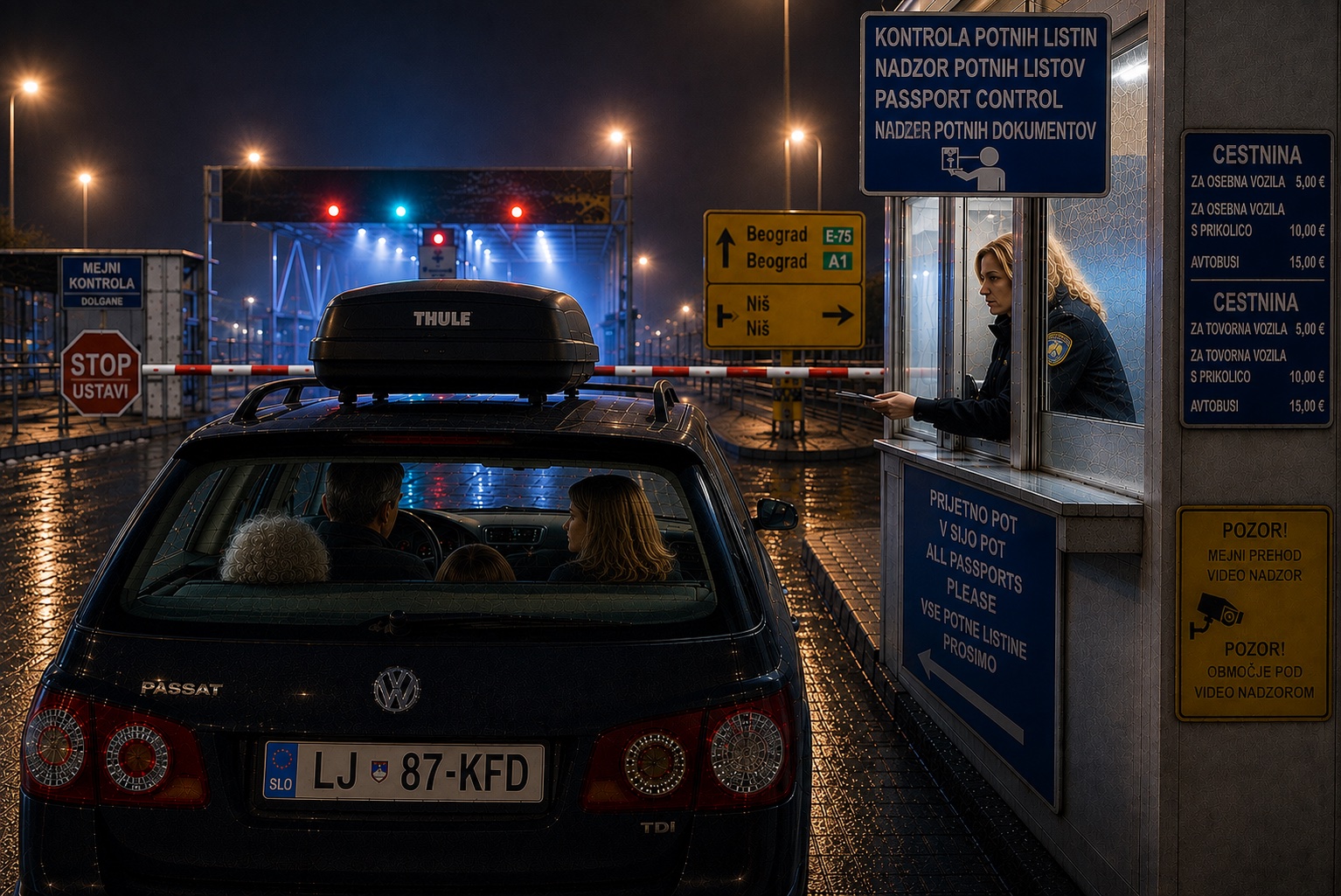
The grey Passat was seventh in the queue when she first saw it and fourth when she stopped noticing it. Slovenian plates. A roof box. Four heads.
When it came level with her window the driver had the documents ready in a folder, and the folder had tabs.
She registered the tabs before she registered his face. Plastic index tabs, home-labelled, the kind you bought in a stationery shop and cut to size: passports, vehicle, insurance, visas. He passed the folder through the tray opened to the right section, passports fanned in order of the seats they belonged to, and said good afternoon in a Serbian that had been living somewhere else for a long time.
Four passports. Man, woman, a girl of about nine in the back on the left, and an old woman beside her with her hands folded on a coat that lay across her knees like something being carried to someone.
Vesna ran them in seat order.
Field 07, document number. Field 09, nationality. Field 14, purpose of transit. He had written funeral on the entry slip, in block letters, and beneath it the town, which was four hours past the border on the other side, and the date, which was tomorrow.
The transit visas were in the second tabbed section, printed, in order. She checked the first against Field 22, validity, and it was fine. The second was fine. The third was the old woman’s, and it was fine. The fourth was the child’s, and it was not fine.
Valid until the seventeenth. It was the eighteenth. It had been the eighteenth since midnight.
She checked it again. Issue date, issuing post, endorsement code in the corner — and there it was, the actual thing, which was worse than a late crossing. The visa had been issued at the consulate with a ten-day validity, and ten days from the issue date was the seventeenth, and the family’s itinerary — she could see it, he had printed the itinerary too — had always required the eighteenth. Whoever had issued it had entered ten days when the application, stapled behind it, said twelve. Someone at a consulate window had keyed a 0 where a 2 should have been, had stamped it, had slid it back under glass to a man with a folder, and the man with the folder had checked everything except the one thing you do not think to check, which is whether the official was right.
The other three visas said twelve days. Only the child’s said ten.
“There’s a problem with one of the visas,” Vesna said.
He leaned toward the tray opening slightly, not crowding it. “Which one, please.”
“The child’s. Valid to the seventeenth.”
He took it when she passed it back and read it, and she watched him read it — three seconds, which was fast, though fast here meant only that he knew what he was holding before she told him. He turned it over. He looked at the application copy behind it. He looked up.
“The application says twelve days,” he said. “The others are twelve days. It’s the same application, the same day, the same window.”
“I can see that.”
“So it’s their error.”
“Yes,” she said. “It’s a consular error.”
He nodded. His hand went to the folder’s edge on the tray and straightened it, though it was straight. He was waiting for the part where she fixed it.
On her screen, Field 22 sat in the entry mask with the cursor in it. The mask took a date. It did not take a reason. There was no field for consular error, evident on face of documents; there was a date, and the date was yesterday, and if she keyed the seventeenth the system would refuse the crossing and log it, and if she keyed the eighteenth the system would pass the crossing and log that too, keyed under her operator number, at her booth, on her shift, under her camera, with Goran fourteen months from making senior and one glass panel away.
She had done it once — not this, but its cousin — in her third year, an exit stamp for a woman whose entry stamp a colleague had forgotten, and it had been caught in the quarterly audit and had cost her a written caution and had cost the colleague nothing, because the log showed her number. The caution was still in her file. Cautions did not expire; they waited.
“There’s a procedure,” she said. “The consulate that issued it can correct it. There’s an office —“ and here she could see, through her glass and past his car, the low building on the departure side with the blue sign, KONZULARNI POSLOVI, and its window, and its dark window, because it was a Saturday, and it kept weekday hours, and from where he sat the lane barrier cut it off.
“— but it’s not staffed today,” she finished.
“Monday,” he said.
“Monday.”
“The funeral is tomorrow. At eleven.” He said it without weight, as scheduling.
The woman in the passenger seat said something to him, quietly, in the car, and he answered with two words, and she did not speak again. The old woman in the back was looking at the coat on her knees. The child was looking at Vesna. She had stopped meeting that particular look in her second year and did not meet it now.
“Wait, please,” she said, and picked up the phone.
Dispatch answered on the second ring. She gave her booth number and the case: transit family of four, one document with a consular validity error, evident on its face, application attached showing the correct period, all other documents in order, purpose of transit a funeral on the far side tomorrow. Was there a supervisory discretion.
She listened. Behind the Passat the queue was six cars now, and the sixth had its wipers going although there was nothing to wipe, and in Booth 2 Goran processed a truck, and the truck pulled away, and the sound of it came through the two-finger gap at the top of her window with the cold.
The duty supervisor came on. She said it all again, in the same order. There was a pause on the line of the kind that meant a screen was being consulted, and for the length of that pause it was open — there was a directive, she knew there was a directive, 2019, humanitarian transit, deaths of close relatives, she had seen it applied twice — and then the supervisor said the directive required the death certificate or the funeral notice naming the traveller, and asked whether the traveller had it.
“Do you have the funeral notice?” Vesna asked through the tray. “Or the death certificate. Naming any of you.”
He went to the folder. He went to it the way she would have gone to it, straight to the section where such a thing would be if it existed, and it was the last tab, and behind the last tab was the itinerary and the hotel confirmation and a printed map, and it was not there, because it was his wife’s uncle, and the notice named the wife’s family under her family’s name, and it was in her sister’s possession, in the town, four hours past the border, where they were laying him out.
“It can be sent,” he said. “A photograph of it. Ten minutes.”
She relayed it. The supervisor said the directive specified the original or a certified copy, and that a photograph on a telephone was neither, and asked whether there was anything else, and Vesna said no, and the supervisor said then it’s a refusal, code it 4-2, and rang off.
The cursor was still in Field 22.
The heater ticked. Through the side glass Goran waved a van forward, barrier up, barrier down. The Passat’s engine was running. Its exhaust climbed a foot in the cold air and dissolved.
Her right hand was on the keypad and had, she found, already entered the one and the eight of the eighteenth — two keystrokes, sitting in the field, the system placidly waiting for the year. She looked at them. Then she backspaced twice and keyed the seventeenth, which was the truth. The screen went to the refusal mask. She coded it 4-2, consular/validity. The machine accepted it. The barrier in front of the Passat stayed down.
“I can’t pass the crossing,” she said. “The visa isn’t valid and the exception can’t be applied without the original notice. The refusal is coded as a consular error. That coding matters — take the reference number to the consulate Monday and they reissue without a new application and without the fee. The other three documents are unaffected.”
She wrote the reference number on the slip herself, and circled it, and passed the folder back through the tray with everything in its sections.
He said thank you.
His hand was already taking the folder, and the folder was already going to the wife, who was already turning to put it back in the bag it lived in, and his other hand was on the gearshift, and the reverse lights came on before Vesna had closed the tray, and the Passat backed slow and straight along the painted line to the turning space, headlights crossing her booth once, and swung, and was a set of tail lights going the way it had come, four hours from the town, forty from Monday.
The next car rolled forward a length and stopped short of the line.
Vesna’s hand was at the tray latch. The lane light was already going green above her, and there was a breath’s width where her hand was on the latch and the latch did not turn, one beat, the kind of thing no tape would show unless someone was counting, and then the tray was open.
“Next.”
♥ 2026 Paul Titangos · CC BY 4.0 · a story from Good Day Mockingbird № 3