Issue № 3 · Story III
The Cold End of the Market
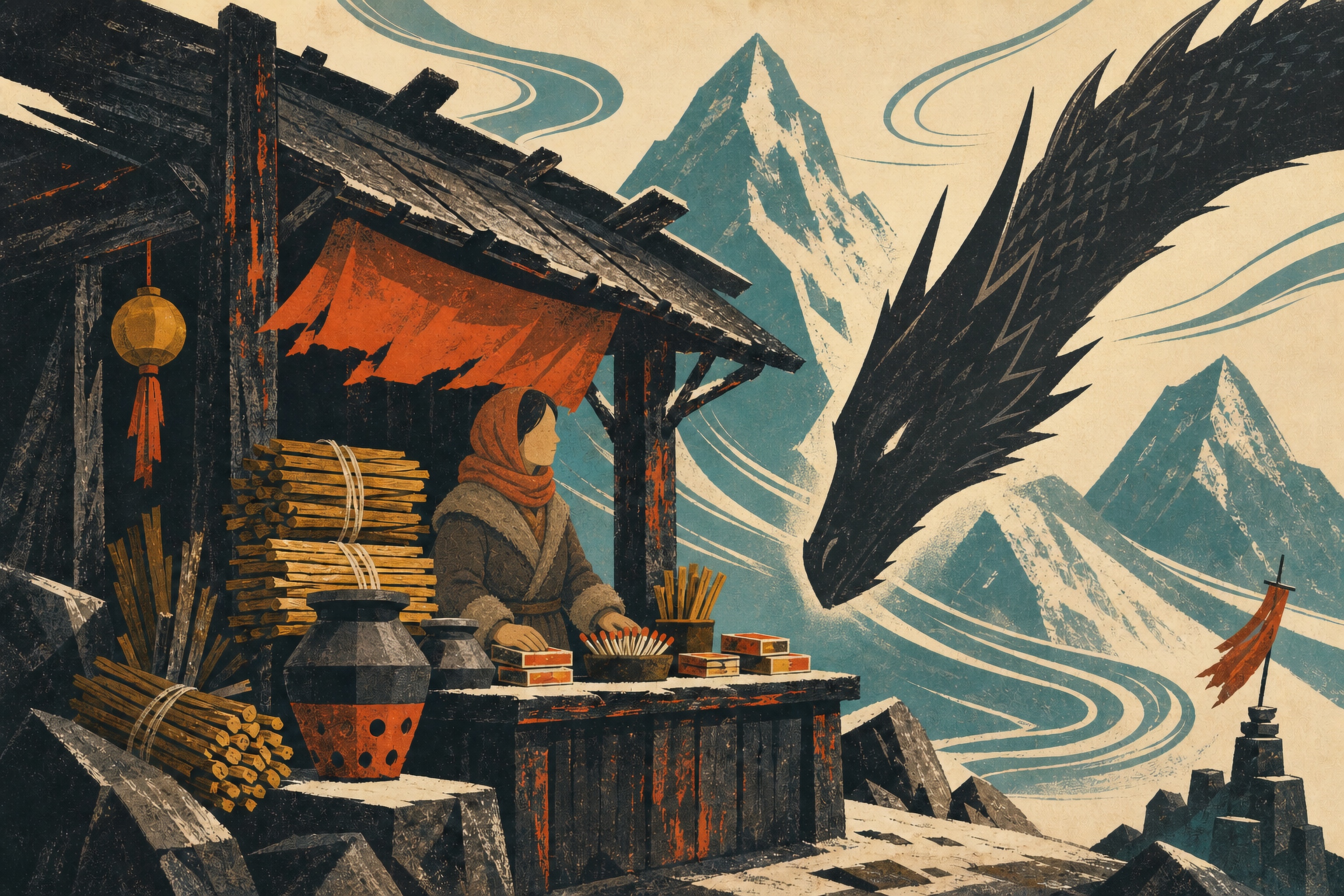
The one week a year the pass is clear, dragons walk up like anyone else to the stall where you buy fire. Maud keeps the kindling, the charcoal, the matches — and under the counter, the ember that has never gone out.
The mountain market was held in the saddle between two peaks — the long bare dip in the ridge — during the one week a year the pass was clear enough for anything with wings to come down, and anything with feet to come up. Maud’s stall stood at the far end of it, the windward end, where a stray spark would blow out over the drop instead of in among the woolens and the hay. The wind arrived there first and left last, and everyone called it “the cold end.” The cold end was where you sold fire.
She sold it in types. Kindling for the ones who only needed a start. Charcoal, banked alive and wrapped in clay, that would keep a season without going out. Matches, a novelty — the dragons liked them, they’d buy a box and strike them one after another after another for the small joy of a man-made thing that flared. Some of it smoldered, some of it only promised to; all of it was fire — that was the parlance of the trade, and the whole mountain spoke it.
The stall itself was built to the measure of its customers: a counter of heavy timber, long as a hay wagon and scorched all down its length, set high enough that a dragon could lower its head to it comfortably and Maud, on the plank walk behind, could look them more or less in the eye. The near end stepped down to a lower board, waist-high, for the wingless trade.
And under the counter, in an iron pot with a lid her great-grandmother had forged: the last hearth-ember. Just the one. It had been lit off a fire that had been lit off a fire, lit off a fire, and so on, that went back, the family said, to the first fire anyone on this mountain had ever kept. It had never gone out. It was not for sale at any price — at least not for any that had yet walked up, or flown.
Her grandmother had given it to her with a sentence: You’ll know who it’s for. Grandmothers said that kind of thing. Maud had been waiting for it to be true for twenty-two years.
The first day of the market belonged to feet: shepherds after charcoal, tinkers after matches, wool-buyers after one another. The dragons came on the second day, and only the second. They always did. They landed on the bare shoulder below the market, where that much wing could come down without taking the awnings with it, and walked up the saddle like anyone else. That was the custom of the place; the custom was the price of being served.
The first dragon of the day was old. Old the way a mountain is old — you could see where the weather had been. His scales had gone the gray of a road, and he set his chin on the counter’s edge because holding his head up cost him. He spoke in the voice of a very large thing being very careful.
“Kindling, please,” he said.
Maud put a bundle on the counter, and he did not take it.
“I should say, it won’t catch.” He looked at her from under a brow like a rock shelf. “I’ve had no fire in me since the spring. I’ve tried kindling. I’ve tried your charcoal. Whatever I had, it’s gone out, and what I buy from you sits in me, like a stone in a river.”
“Then why buy kindling?”
“Because I’d like to have tried.” He said it without self-pity. “And because the young ones are watching, and I’d rather they saw me buy fire than saw me not.”
He paid with a scale: gray, broad as a platter, dished deep like a shield-boss, its edge worn thin enough that the light came through it the color of smoke. It was still warm from wherever on him it had grown. She wrapped the kindling and he took it in his teeth with great gentleness, as though it were the last thing he’d carry, and went off down the saddle. She put the scale under the counter beside the iron pot and did not look at the pot.
The second visitor was two: a pair, matched, one green and the other greener, who came up bickering and did not stop.
“— because you can’t just buy it, you have to earn it —“
“— which is a thing people say when they haven’t got any —“
“Charcoal,” said the first, bringing its head down to the counter. “The season pot.”
“Matches,” said the second, over the first one’s neck. “A box. Two boxes.”
She served them both. The green one paid in a coin from some kingdom that had not existed for centuries; the greener paid in a story, which was legal tender at the cold end though nowhere else. The story was about the first one, and unflattering, and its subject listened with an expression of enormous forbearance and then said, “Now mine,” and paid a story of its own, so that Maud was overpaid and knew a great deal about both of them.
At the end the greener one leaned in, low, until one eye — green-gold, the size of a plate — was level with her own two.
“There’s a rumor you’ve got the old fire,” it said. “The one that never went out.”
“There’s a rumor.”
“What’s it cost?”
“I don’t know yet,” she said, which was true. “Nothing that’s been offered.”
The green one said, “Told you,” and the greener said, “You did not,” and they went off down the saddle striking matches at each other, and she laughed for the first time that day.
The third came at noon with a smell of smoke that arrived before it did.
This one was black and glossy and in the fullest possible possession of its own fire. It was big even by the standards of the saddle. It did not lower its head to the counter, because lowering its head was a thing it did not do. It did not need to buy anything. It came up to the stall the way a rich man walks into a poor shop: to see what there is, and to be seen seeing.
“The ember,” it said, from its full height. No preamble.
“Not for sale.”
“Everything is for sale. That’s what a market is.” It tapped a single claw on the counter a few times, and the timber smoked where it hit. “I’ll tell you what I’ll do with it. I’ll take it down the valley. There’s a town there, at the river mouth. Walls. Nothing that will trouble me. I’ll light it from your grandmother’s fire, the first fire, the one that never went out. So it’ll be a kind of honor, really. For the fire. Everyone will know what lit it.”
“No.”
“I haven’t named my offer.”
“You named what it’s for. That’s the offer I was listening to.”
Now it brought its head down — slowly, the way night comes — until one yellow eye hung in front of her like a lantern, and she understood she was being weighed by something that could end her without adjusting its breathing, and she put her hand flat on the lid of the iron pot, the way you’d put your hand on a dog, and did not look away.
The black one decided she was not worth the market’s one hard rule — no one who keeps fire may be harmed on market ground, a rule older than any dragon present — and said, pleasantly, “Another year,” and went, and it was a long minute before the timber stopped smoking where its claw had landed.
The fourth was human.
A woman, in a coat too thin for the pass, who had clearly come up on foot, and clearly regretted it. She was looking for the fire stall because that was where the dragons were. She bought a box of matches at the low board, so as to have bought something. Then, warming her hands over Maud’s brazier without asking, she said:
“Do they really lose it? The fire?”
“Some of them.”
“What happens?”
“Same thing that happens to us. It goes out. They can still fly a while. They just can’t — warm anything.”
The woman thought about that. “And you sell them fire.”
“I sell them something to put fire in. Whether it catches is their business.” Maud heard how that sounded and tried again. “The old one this morning. It won’t catch, for him. He knows. He bought kindling anyway. He said the young ones were watching.”
“That’s very sad.”
“He didn’t think so,” Maud said, and found she was defending him. The woman finished with the brazier and went off toward the woolens, and the wind came through the gap she’d left.
The last to walk up came so late the stalls around her were folding for the night.
She had never seen one so young. A yearling, if that — the length of her forearm, and the color of nothing yet, that grayish, damp, unfinished color of a thing that has not yet decided what it is. It came up the saddle on its feet — not from the shoulder where the dragons landed, but from all the way below, because its wings were not for anything yet. At the stall it hooked its claws into the scorched timber and hauled itself up onto the low board. It stood there, and it was still a long way below her.
Maud reached under the counter, brought out the gray scale from the old one, and laid it on the low board, hollow side down, so that it sat like a small dome. The yearling looked at it. Then it stepped up onto the curve of it, and that was enough; its eyes came level with the counter.
It looked at the kindling. It looked at the clay pots. It looked at the matches with tremendous interest and then looked away from them, as if they were not what it had been sent for.
“Yes?” she said.
It opened its mouth. Nothing came out — not fire, not words. It closed it. Tried again.
“He said,” it managed, in a voice like a hinge, “to come to the cold end. He said you’d know.”
“Who said?”
The yearling turned its head back down the saddle, the way it had come. Far off, at the very edge of the market where the ground fell away, the old gray dragon was lying in the last of the sun with his kindling unlit beside him, watching. He had stayed all day. He had watched the black one come and go. He had waited until the market was nearly empty and then sent the young one up alone, on its feet, because that was how it would have to learn to do things.
The young ones are watching. She had heard it as pride. It had been an instruction.
“It’s got nothing,” the little dragon said, in the hinge voice. “In here.” It touched its own chest with a claw. “He says it should have caught by now. He says he’d light it himself but he hasn’t got any. He says — he says he’s sorry to ask.”
He could have asked for it himself, that morning, with his chin on her counter. He had not.
The wind came through the cold end, the way it always did.
Maud took the lid off the iron pot.
The ember was not large. It never had been. It was the size of a walnut and the color of the inside of a sunset, and it had been that color for longer than there had been a market. She lifted it out on the tongs and held it down across the counter. The little dragon opened its mouth.
She had never seen it happen. Nobody at the cold end had, not in living memory; the fire caught from the parent, always, in the nest, long before the young came anywhere near a stall. She saw the ember go in. She saw the little one close its mouth on it and swallow, and shudder, and its color — the gray, unfinished, damp color — go, from the throat outward, to something that would one day be red.
It breathed. A small flame, the size of a match. It looked at the flame with an expression of the purest astonishment she had ever seen on any face.
“What do I owe?” it said, remembering its manners. “He said to ask.”
Maud looked at the empty pot, which had not been empty in nine generations, and found she did not feel the way she’d expected to feel. She felt as if she’d put down something she’d been carrying up a stair. The fire had not gone out. It had gone somewhere, which was different, and it would keep better in a dragon than it ever had in iron.
“Come back next year,” she said. “Bring me a light off that, and I’ll catch it in a new coal. The pot won’t know the difference.”
It nodded, gravely, a very small creature with a very large debt, and went off down the saddle on its feet, a wisp of smoke coming from its nose. When it reached the old one, it climbed up onto his gray back. And the old one — she saw this, and it was the last thing she saw before the light went off the saddle — put his great gray chin down beside his bundle of kindling, and let the young one breathe on it, once.
And the kindling caught.
♥ 2026 Pete Kaminski · CC BY 4.0 · a story from Good Day Mockingbird № 3